
Enteric-Coated Probiotic Capsules: Formulation & Benefits
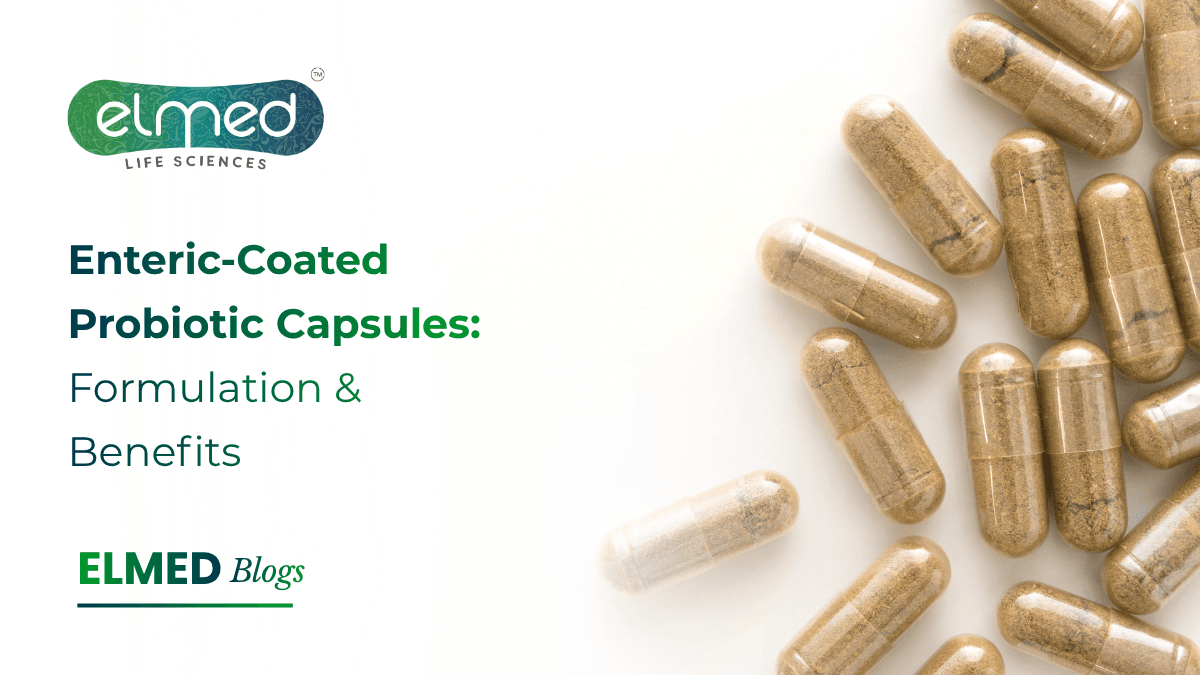
Enteric-coated probiotic capsules are designed to protect sensitive probiotic strains during gastric transit, but coating choice, stability, and release performance must be validated.


Introduction
Enteric-coated probiotic capsules are designed to protect probiotic microorganisms from the acidic conditions of the stomach and delay release until the capsule reaches the higher-pH environment of the intestinal tract. The goal is straightforward: preserve viable microorganisms through gastric transit and release them where they are intended to act.
For probiotics, that is not a trivial formulation problem. Many microorganisms are sensitive to acid, moisture, oxygen, temperature, and processing conditions.
An enteric coating can be useful, but it is not automatically the best solution for every probiotic strain. The coating, capsule shell, formulation matrix, packaging, and probiotic itself all need to work together.
Why Protect Probiotics From Gastric Conditions?
After oral administration, a probiotic product passes through several environments before reaching the intestine.
The stomach presents an acidic environment that can reduce the viability of acid-sensitive microorganisms. The duration of exposure also varies with factors such as gastric emptying and food intake.
For a strain that is particularly vulnerable to gastric conditions, protecting the probiotic during this stage can improve the likelihood that viable cells reach the intended intestinal environment.
This is the basic rationale behind enteric protection.
It is not simply about adding another layer to the capsule.
How Does an Enteric Coating Work?
Enteric coatings are designed to remain relatively intact under acidic gastric conditions and dissolve or become permeable at a higher pH.
This behavior is achieved through coating polymers with pH-dependent dissolution characteristics. The specific polymer system and coating thickness influence how the finished dosage form behaves during gastrointestinal transit.
For probiotic products, the target is a controlled balance:
1. Protect the probiotic during the gastric phase.
2. Avoid premature release.
3. Allow appropriate release under intestinal conditions.
4. Preserve probiotic viability throughout manufacturing and storage.
A coating that remains intact too long can delay release unnecessarily. One that dissolves too early provides limited gastric protection.
The formulation has to be tested rather than assumed to work.
Strain Selection Still Comes First
Enteric coating cannot compensate for poor strain selection.
Different probiotic microorganisms have different acid tolerance, moisture sensitivity, oxygen sensitivity, and processing requirements. Some strains may already demonstrate relatively good survival under gastric conditions, while others require additional protection.
The formulation team should therefore characterize the selected strain before deciding whether enteric protection is necessary.
Well-characterized strains such as Lactobacillus rhamnosus GG and Bifidobacterium animalis subsp. lactis BB-12 have been widely studied in probiotic applications, but their inclusion in a product does not automatically determine the need for an enteric coating.
The intended health application matters too.
A probiotic intended primarily for an intestinal target may have a stronger rationale for delayed release than a product for which gastric exposure is part of the intended delivery strategy.
Enteric Coating and Probiotic Viability
The coating process itself can create stress.
Probiotic microorganisms are biological materials. Exposure to solvents, water, heat, mechanical forces, or prolonged processing conditions can reduce viability depending on the strain and formulation.
This means the coating process needs to be compatible with the probiotic.
A formulation scientist should evaluate factors such as:
· Coating process temperature
· Moisture exposure
· Drying conditions
· Mechanical handling
· Polymer compatibility
· Effect on capsule integrity
· Final probiotic viability
The coating should protect the microorganism without creating a larger manufacturing problem than the one it was intended to solve.
Capsule Shell Selection Matters
The enteric coating is only one component of the delivery system.
Capsule shell composition can influence moisture content, mechanical properties, processing behavior, and compatibility with the probiotic formulation.
Hard capsules may be manufactured using materials such as gelatin or hydroxypropyl methylcellulose (HPMC). The choice depends on product requirements, manufacturing considerations, consumer requirements, and compatibility with the formulation.
The interaction between the capsule shell, probiotic powder, coating system, and packaging should be assessed during development.
A formulation that looks stable at the powder stage can behave differently once encapsulated and coated.
Moisture Control Is a Major Concern
Moisture is one of the most common threats to probiotic stability.
Many probiotic organisms are sensitive to water activity, and exposure to humidity during processing or storage can accelerate viability loss.
Enteric coating does not remove this concern.
The formulation should therefore be developed with appropriate moisture control from blending through encapsulation, coating, packaging, and storage. Environmental humidity during manufacturing may also need to be controlled according to the sensitivity of the selected strain.
Packaging then provides another layer of protection.
High-barrier packaging, suitable sealing systems, and appropriate storage conditions can help limit moisture ingress throughout shelf life.
Testing Should Demonstrate Gastric Protection
An enteric-coated probiotic capsule should not be considered successful simply because the coating passes a visual inspection.
Performance testing should demonstrate that the dosage form behaves as intended under simulated gastrointestinal conditions.
Development studies can evaluate:
· Resistance under acidic conditions
· Release under intestinal pH conditions
· Probiotic viability before and after simulated gastric exposure
· Dissolution or disintegration behavior
· Coating integrity
· Viable count throughout stability testing
These tests connect the coating technology to the actual product objective.
The question is not "Does it look enteric-coated?"
The question is "Does it protect the probiotic and release it appropriately?"
Packaging and Shelf-Life Stability
A probiotic capsule needs to remain stable from production to consumption.
Enteric-coated products should therefore undergo appropriate stability evaluation under proposed storage conditions. Testing should monitor viable count alongside relevant physical and chemical attributes of the dosage form.
Moisture ingress can affect both the probiotic and the coating system. Temperature exposure can also influence stability.
Packaging selection should be based on the sensitivity of the formulation rather than convenience alone. Bottles, blister packs, desiccant systems, and high-barrier materials each offer different approaches to moisture protection.
The final package should be validated as part of the product, not treated as a separate commercial decision.
When Is Enteric Coating Worth Considering?
Enteric coating is particularly worth investigating when the selected probiotic demonstrates meaningful sensitivity to gastric conditions and the intended application requires delivery to the intestinal tract.
It may also be attractive when the formulation strategy calls for delayed release and the development team can demonstrate that the coating process does not compromise viability.
It is not automatically necessary for every probiotic capsule.
If a strain has adequate survival without enteric protection, adding a complex coating system may increase manufacturing cost and development burden without delivering a meaningful formulation advantage.
The science should drive the decision.
Common Formulation Mistakes
One common mistake is assuming that every probiotic needs enteric protection.
Another is selecting the coating polymer before characterizing the probiotic strain.
Coating thickness can also be treated as a purely manufacturing parameter when it actually affects release performance.
A further mistake is focusing on gastric resistance while ignoring what happens after the capsule reaches intestinal conditions. Delayed release is useful only if the product subsequently releases the probiotic appropriately.
Finally, manufacturers sometimes evaluate the coated capsule immediately after production but do not adequately assess performance through shelf life.
That is where many formulation problems become visible.
Key Takeaways
· Enteric-coated probiotic capsules are designed to protect probiotics during gastric transit and support intestinal release.
· The need for enteric protection depends on the strain, intended application, and demonstrated gastric sensitivity.
· Coating materials, coating thickness, capsule shell, and processing conditions all influence performance.
· Moisture control remains essential even when an enteric coating is used.
· Coating processes must be compatible with probiotic viability.
· Simulated gastrointestinal testing should demonstrate acid resistance and appropriate intestinal release.
· Stability testing should confirm both probiotic viability and dosage-form performance throughout shelf life.
· Enteric coating should be used when the formulation evidence supports it, not simply because it sounds technically superior.
The Bottom Line
Enteric coating can be a valuable technology for probiotic capsules, particularly when gastric exposure represents a significant viability challenge. But the coating itself is not the product strategy.
A successful formulation begins with the right strain and a clear delivery objective. From there, the capsule shell, coating system, manufacturing process, packaging, and stability program need to be designed as one system.
For probiotic manufacturers, the strongest development approach is simple: characterize the strain, define the desired release profile, test the coating under relevant conditions, and confirm viability through shelf life.
If the coating protects the probiotic but the process destroys viability, the formulation has missed the point.
Frequently Asked Questions
Explore More Articles
 Guide
GuideHow to Launch Your Own Probiotic Brand
Learn how to launch your own probiotic brand, from strain selection and formulation to contract manufacturing, testing, packaging, compliance, and market launch.
 Guide
GuideImportance of In-House R&D in Probiotic Manufacturing
In-house R&D helps probiotic manufacturers control strain selection, formulation, stability, scale-up, testing, and product development from concept to commercial production.
 Guide
GuideQuestions to Ask a Probiotic Manufacturer
The right questions can help brands evaluate probiotic manufacturers for strain expertise, formulation quality, stability, compliance, documentation, and production capabilities.
Stay in the Loop
Get the latest probiotic industry insights delivered to your inbox.