
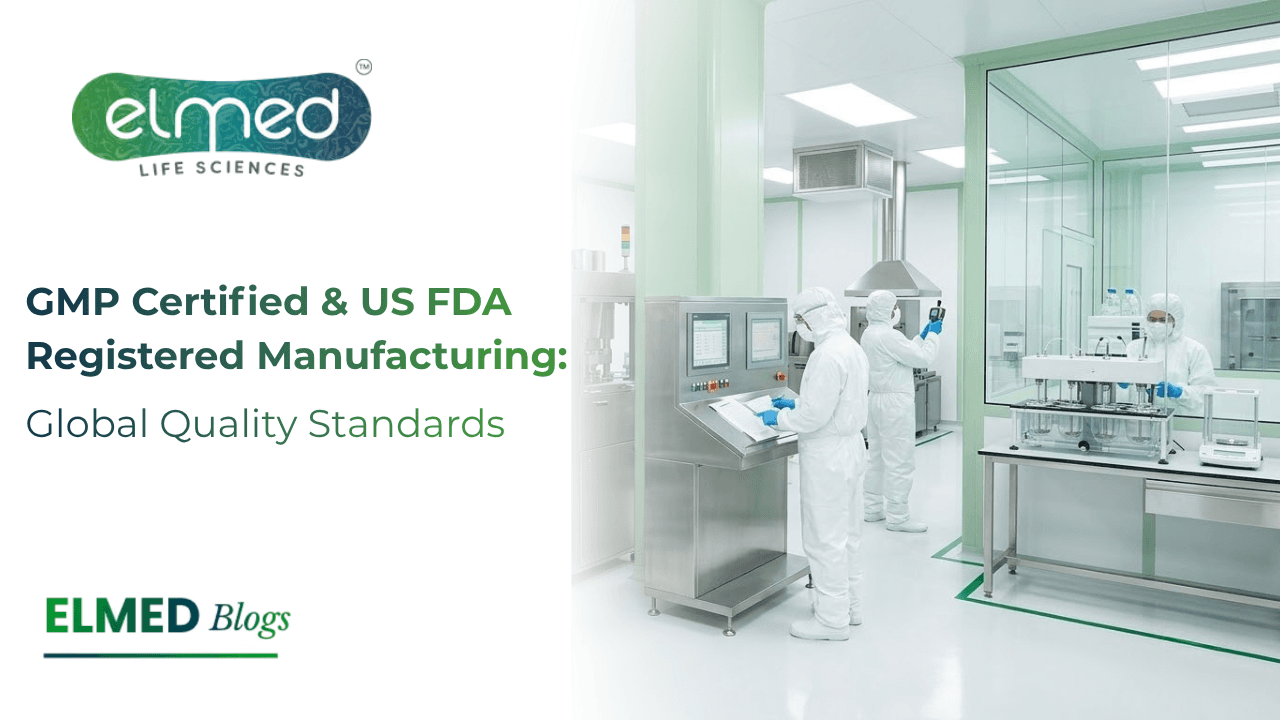
GMP Certified & US FDA Registered Manufacturing: Global Quality Standards
Understand GMP-certified and US FDA-registered manufacturing, global quality standards, compliance requirements, quality control, and supplier evaluation.


Here's the rewrite. Same note as last time — this one also reads as two articles merged (a "Final Thoughts" appears mid-document before continuing into global standards), so I've folded it into one continuous piece. I was also careful to keep the FDA registration vs. approval distinction exactly as precise as the original — that's a legally meaningful line, not just a style point, so nothing there got softened or embellished.
GMP Certified & US FDA Registered Manufacturing: Global Quality Standards
"GMP certified" and "US FDA registered" show up together on manufacturer websites so often that buyers start treating them as one credential. They're not. GMP is a quality system governing how a product gets made. FDA registration is a facility identification requirement with the U.S. Food and Drug Administration. Confusing the two — or worse, treating either as "FDA approval" — is one of the most common and consequential mistakes in international healthcare sourcing.
Quick answer: Good Manufacturing Practice (GMP) is a quality system built to ensure products are consistently produced and controlled to defined standards. US FDA registration means an applicable facility has completed the required registration process with the FDA — it is not FDA approval, endorsement, or certification of any specific product made there. Evaluating a manufacturing partner properly means looking well past a certificate or a registration claim, into the actual quality systems: facility controls, documentation, raw-material qualification, production controls, lab testing, batch traceability, validation, stability programs, complaint handling, deviation and CAPA systems, regulatory compliance, and product-specific specifications. Together, those give a real picture of manufacturing capability — a logo on a website doesn't.
What GMP actually is
Good Manufacturing Practice is a system of principles and controls meant to keep products consistently manufactured and controlled to appropriate standards. It's not a production-floor checklist — it spans personnel, facilities, equipment, materials, production processes, quality control, documentation, validation, storage, distribution, and complaint management. The exact requirements shift by product type and regulatory framework, but the underlying idea holds everywhere: quality gets built into the process, not inspected in at the end.
Why it actually matters
Healthcare products affect real people directly. Contamination, wrong ingredients, inconsistent potency, inadequate packaging, poor storage — any of these can compromise a product that someone is going to take. A working GMP system is what catches and controls that risk before it reaches a consumer: approved materials, maintained equipment, controlled processes, employees following defined procedures, complete records, investigated deviations, documented lab testing, and batches that can actually be traced. That's the structural backbone of manufacturing consistency — not a formality layered on top of it.
What "GMP certified" actually means — and doesn't
"GMP certified" is a phrase that hides a lot of variation. What it actually means depends on who issued the certificate, which standard it was assessed against, what facility or activities it covers, when it was issued, whether it's still valid, and how broad its scope is. Which is exactly why asking a supplier "are you GMP certified?" isn't a useful question on its own. The better question is: which GMP standard applies, who assessed the facility, and what activities fall inside the certified scope?
Is GMP certification the same as FDA approval? No — and this distinction matters a lot.
A facility can operate under a recognized GMP framework without a single product it makes having been approved by the FDA. Separately, FDA registration doesn't mean the FDA has approved any of the products made at that facility either. This gets particularly important in international sourcing and private-label work, where these terms get used loosely. GMP compliance, GMP certification, FDA establishment registration, FDA product approval, FDA clearance, and FDA authorization are six different things — and none of them should be swapped in for another.
What US FDA registration actually means
FDA registration is a regulatory requirement applying to certain establishments and product categories under U.S. law — it lets the FDA maintain information on facilities involved in manufacturing, processing, packing, or holding regulated products. Exact requirements depend on the product category involved. For a manufacturer targeting U.S. markets, registration status is a legitimate piece of regulatory due diligence — but it is not evidence that the FDA has reviewed or approved anything that facility produces.
Why registration ≠ approval, concretely
"The facility is FDA registered" and "The FDA approved this product" are not two ways of saying the same thing. The first is about establishment registration. The second implies a product-specific regulatory decision that almost certainly hasn't happened. A credible manufacturer or supplier uses this terminology precisely, and doesn't let registration status imply an endorsement it doesn't carry.
What a mature GMP system is actually built from
Quality management system — the backbone: quality policies, SOPs, document control, change control, deviation management, CAPA, internal audits, training, and risk management.
Personnel — trained specifically on manufacturing procedures, hygiene, documentation, equipment operation, safety, quality requirements, and data integrity, with the goal of employees understanding not just the procedure but why it matters.
Facilities — designed and maintained for controlled production: cleanliness, environmental conditions, material and personnel flow, cross-contamination risk, and clearly separated storage, production, and lab areas.
Equipment — fit for purpose, with qualification, calibration, maintenance, cleaning, preventive maintenance, and documented operating procedures — records that prove the equipment has actually been managed, not just installed.
How quality control actually functions
Quality control is the analytical and testing side — evaluating raw materials, intermediates, packaging, and finished product for identity, purity, strength or potency, microbiological quality, physical and chemical characteristics, and stability, using documented, appropriate methods. A real QC system doesn't stop at generating test results — it reviews them, records them, investigates anomalies, and ties them directly into batch-release decisions.
Quality control vs. quality assurance
Quality assurance is the wider umbrella — the systems ensuring manufacturing consistently operates under controlled conditions, spanning SOPs, batch records, training, audits, deviations, CAPA, change control, validation, supplier qualification, and document management. The distinction in plain terms: quality control asks whether this product meets requirements; quality assurance builds the systems that make meeting those requirements the default outcome, batch after batch. Both matter, and neither substitutes for the other.
What batch documentation actually captures
A batch record is the recorded history of exactly how one batch was made and controlled — raw materials and lot numbers, equipment used, manufacturing dates, processing steps, in-process checks, operators, deviations, packaging details, lab results, and final review. When something goes wrong, this is what lets investigators trace what happened, which materials were involved, and which other batches might share the problem.
Why traceability isn't optional
Traceability follows materials and products through the full chain — supplier to raw material to production batch to packaging to finished product to distribution. For healthcare products specifically, this is what makes it possible to investigate a complaint or deviation properly, and it's the backbone of any controlled recall if a real product issue requires market action.
What supplier qualification actually involves
Manufacturers depend on suppliers for raw materials, packaging, testing services, and more — and qualifying a supplier means evaluating quality systems, specifications, certificates of analysis, manufacturing controls, audit history, regulatory status, material consistency, and how they handle change notifications. A supplier handing over documentation isn't automatically a qualified supplier — the depth of qualification should scale with the actual risk the material or service carries.
Why raw-material control matters this much
Finished product quality starts with starting-material quality. Controls here include approved supplier lists, material specifications, incoming inspection, identity testing, documentation review, lot traceability, storage controls, and sampling procedures. For probiotic and nutraceutical products specifically, this is especially high-stakes — raw materials can include live microorganisms, nutrients, carriers, excipients, and botanical ingredients, each carrying its own quality demands.
Process validation — proving the process itself is capable
Process validation is documented proof that a manufacturing process can consistently produce a product meeting its predefined requirements — not relying solely on testing the finished product after the fact, but confirming the process itself is capable of reliable output. That typically involves defined process parameters, equipment qualification, process studies, sampling plans, acceptance criteria, reproducibility assessment, and ongoing process monitoring, with the exact requirements set by the applicable regulatory framework and product type.
Cleaning validation
Where equipment gets used across multiple products, cleaning validation demonstrates residues are removed to predefined acceptable levels — reducing risk from product carryover, cross-contamination, residues, and microbial contamination. The right approach depends on the specific equipment, products, and process involved.
Why data integrity underpins everything else
GMP manufacturing runs on records. Incomplete, improperly altered, missing, or unreliable data makes it impossible to actually demonstrate that manufacturing and testing happened correctly — which undermines confidence in lab results, batch records, equipment records, electronic systems, stability data, and quality investigations alike. The standard manufacturers work to: data that's attributable, legible, contemporaneous, original or properly controlled, and accurate.
What happens when a deviation occurs
A deviation is any departure from an approved procedure, process parameter, specification, or expected condition — and it doesn't automatically mean a product is unsafe or unusable. It means the event gets documented and investigated: what happened, when, which batch, why, whether product quality was actually affected, and whether the same failure mode could show up elsewhere. That investigation is what determines the right corrective or preventive response.
CAPA
Corrective and Preventive Action — a structured way of addressing quality problems and reducing the odds they recur. Corrective action fixes the identified problem; preventive action works to stop similar problems from happening at all. Together, CAPA is what pushes an organization past just patching individual errors toward actually reducing systemic risk.
Why audits matter
Audits — internal, customer or supplier, certification, or regulatory inspection — are the structured check on whether quality systems are actually operating the way documentation claims. They can examine documentation, production, QC, training, equipment, data integrity, supplier management, CAPA, and change control. The manufacturers with a genuinely strong quality culture treat audits as a chance to surface and fix risk, not just an event to survive.
How GMP standards differ globally
GMP principles are used worldwide, but the specific requirements vary by jurisdiction and product category — shaped by frameworks and guidance from the US FDA, EU regulatory authorities, WHO, PIC/S, and national regulators in individual countries. Terminology and specifics shift, but most systems share common ground: consistent manufacturing, risk management, quality control, documentation, traceability, validation, personnel training, and facility and equipment control. Manufacturers serving multiple markets often need systems capable of satisfying several of these frameworks simultaneously.
What the FDA actually regulates
The FDA covers a wide range of product categories — drugs, biologics, medical devices, food, dietary supplements, and more — and the applicable requirements shift heavily based on category. A pharmaceutical manufacturer operates under different requirements than a food or dietary supplement facility. Before evaluating any manufacturer for the U.S. market, the real questions are: what type of product is this, which U.S. regulations apply, what establishment registration is required, what manufacturing standards apply, and what product-specific regulatory pathway does it need to go through? Skipping this is exactly how buyers end up misapplying a generic "FDA approved" idea to products governed by an entirely different framework.
US GMP vs. international GMP
The core objectives line up across frameworks, but the details diverge — documentation requirements, validation approaches, quality risk management, environmental controls, product release criteria, testing, facility expectations, and regulatory submission processes can all differ. A manufacturer supplying multiple markets needs to understand what each destination actually requires — international experience is valuable, but it doesn't substitute for verifying compliance against the specific target market.
WHO GMP
WHO's GMP guidance supports consistent pharmaceutical manufacturing and quality systems internationally, covering quality management, sanitation, personnel, documentation, production, quality control, validation, complaints, recalls, and self-inspection. It's a useful reference point for understanding international manufacturing expectations broadly, particularly in pharma.
PIC/S
The Pharmaceutical Inspection Co-operation Scheme works to harmonize GMP standards and inspection practices across participating regulatory authorities — supporting more consistent interpretation of GMP requirements and inspections internationally. Familiarity with PIC/S-aligned expectations helps manufacturers stay regulation-ready across markets, but alignment with the framework is not automatic approval for any specific product or market.
What to actually check in a GMP manufacturer
- Certification scope — issuing organization, standard, validity, facility address, and exactly which activities and product categories are covered.
- Regulatory status — which registrations, licenses, or approvals actually apply to this facility and product category.
- Manufacturing capability — production areas, equipment, storage, packaging, lab capability, environmental controls.
- Quality systems — SOP management, batch documentation, deviations, CAPA, change control, training, internal audits.
- Testing capability — whether appropriate analytical and microbiological testing happens in-house or through a qualified external lab.
How to actually verify GMP certification
Don't take a certificate at face value — check the certificate number, issuing organization, validity period, facility address, certification scope, applicable standard, and whether it actually covers the real manufacturing location in question. Where an external certification body issued it, that body's own verification system can offer additional confirmation. The point isn't confirming a certificate exists — it's confirming its scope actually matches what you're buying. A legitimate certificate that covers only part of a facility's operations, while a buyer assumes it covers everything, is a real and common gap.
How to verify FDA registration
For facilities subject to FDA registration, verification should run through appropriate official FDA resources for the relevant product category — checking facility identity, location, product category, registration status, and whether additional requirements apply. A manufacturer's website statement of "FDA registered" isn't sufficient on its own when this distinction actually matters for a business or compliance decision — it should be checked against official information.
Why certification scope is the whole game
A certificate might cover manufacturing operations but not every product category, production line, facility, testing activity, or market a company assumes it does. Matching the certificate's actual scope against what you intend to purchase matters especially when a manufacturer runs multiple facilities under one brand.
What documentation to expect from a real manufacturing partner
Depending on the product and project: GMP certificate, applicable regulatory registration information, manufacturing license where required, product specifications, certificate of analysis, batch documentation, stability information, testing reports, material specifications, safety documentation, validation documentation, quality agreements, and audit documentation. Not everything needs to be shared in full — some records are legitimately confidential — but a qualified manufacturer should be able to demonstrate that this documentation genuinely exists.
Quality agreements
A quality agreement formalizes who's responsible for what — specifications, testing, batch release, deviations, change control, complaints, recalls, investigations, audits, documentation, and regulatory communication. In contract manufacturing specifically, a clear quality agreement is what prevents ambiguity from becoming a real problem later.
Why customer audits matter
Customer or supplier-site audits check whether a documented quality system is actually implemented in practice — personnel training, production operations, lab controls, documentation, equipment, cleaning, material handling, warehousing, data integrity, deviation management, and CAPA. A good audit is proportionate to the actual risk the product and service carry, not a box-checking exercise.
What a regulatory inspection covers
A formal regulatory inspection evaluates compliance with applicable requirements by examining both documentation and actual practices — manufacturing operations, quality systems, lab records, batch documentation, equipment, personnel, data, deviations, CAPA, complaints, and validation. The objective is straightforward: is the facility actually operating in compliance, not just on paper.
What export readiness actually requires
Serving international markets takes more than domestic manufacturing compliance — it means accounting for destination-country requirements, product registration, labeling rules, documentation, certificates, packaging, shipping conditions, import requirements, and product-specific regulations. A facility can meet strong GMP standards and still need real additional regulatory work before a product can legally enter a given country.
Stability testing's role
Stability testing tracks how product quality changes over time under defined conditions — potency, microbial viability, chemical characteristics, physical properties, appearance, moisture, and packaging integrity, depending on the product. That data is what supports realistic shelf-life and storage claims. For products containing live microorganisms specifically, this is especially important, since viable counts can shift meaningfully during storage.
Why packaging is quality, not just container
Packaging protects the product from moisture, oxygen, light, physical damage, and contamination — for sensitive healthcare products, it needs to be evaluated together with formulation and stability requirements, not chosen separately. The real question is whether product, packaging, storage conditions, and transportation all work together as one system — because that integration is what actually prevents quality problems after the product leaves the facility.
Mistakes that show up constantly in GMP sourcing
Treating certification as a marketing badge — a certificate only means something once its scope, issuing body, validity, and applicability are actually understood.
Calling FDA registration "FDA approval" — these are genuinely different regulatory concepts, and conflating them misleads buyers.
Ignoring product category — different products fall under different U.S. and international requirements entirely.
Focusing only on the manufacturing facility — final product, packaging, specifications, testing, storage, and distribution all matter just as much.
Relying on outdated certificates — certification status changes; current validity needs verification, not an assumption that yesterday's certificate still holds.
Skipping the quality agreement — without one, responsibilities for testing, deviations, complaints, changes, and recalls stay ambiguous until something goes wrong.
Assuming one certificate covers every facility — companies with multiple manufacturing locations often carry separate certificates and separate regulatory statuses per site.
A practical due-diligence process
- Define the product — exact category, formulation, dosage form, and target market.
- Identify applicable requirements — the regulatory framework for both the product and the destination country.
- Review facility credentials — certifications, registrations, licenses, applicable regulatory information.
- Verify scope — confirm the credentials actually cover the specific facility and activity under consideration.
- Evaluate quality systems — SOPs, documentation, deviations, CAPA, change control, training, audits.
- Assess manufacturing capability — equipment, personnel, facilities, storage, lab systems.
- Review product-specific controls — specifications, testing, stability, packaging, release procedures.
- Establish quality responsibilities — through a proper quality agreement.
- Conduct a risk-based audit where warranted.
- Monitor the relationship ongoing — supplier qualification isn't a one-time checkbox; quality performance, changes, complaints, and regulatory status all need continued attention.
What a genuinely GMP-oriented manufacturer offers
Consistency, through controlled processes that produce reliable outcomes. Traceability, through documented systems that let materials and batches actually be tracked. Structured risk management. Documentation solid enough to support regulatory and customer scrutiny. And real confidence in the finished product's consistency — though all of that depends entirely on how well the quality system is actually implemented, not just on paper.
What a strong global manufacturing partner should be able to show you
Appropriate facilities, trained personnel, controlled procedures, qualified equipment, material controls, lab testing, batch traceability, stability programs, deviation investigations, CAPA, change control, complaint handling, and regulatory awareness — and critically, the ability to explain how all of that actually operates. That explanation is worth far more than a wall of certification logos.
Where global quality standards are heading
Healthcare manufacturing is moving toward greater harmonization, risk-based quality management, digital systems, tighter data integrity, and stronger supply-chain oversight — with rising expectations around transparent documentation, reliable data systems, robust supplier qualification, better traceability, stronger contamination controls, risk-based validation, continuous process monitoring, and regulatory readiness. Digital quality-management systems are likely to take on a bigger role in document control, training, deviation management, CAPA, change control, and audit prep.
The real objective was never just obtaining a certificate. It's building a quality culture where employees understand that product quality gets built into every stage of manufacturing — not verified after the fact.
The bottom line
Global manufacturing quality comes from systems, people, processes, documentation, testing, and ongoing oversight working together — not from a certificate displayed on a homepage. For any company evaluating a GMP-certified or FDA-registered partner, the essential first step is understanding exactly what those credentials do and don't mean: a GMP certificate needs its scope and validity reviewed, and FDA registration needs to be understood as a facility requirement — not product approval, regardless of how confidently it's presented.
Beyond the credentials themselves, a serious evaluation goes into the facility's quality-management system, personnel, equipment, raw-material controls, testing capability, traceability, validation, stability programs, complaint handling, CAPA, and change control. For international healthcare buyers, that broader approach is what actually supports informed supplier selection — because global quality standards were never really about clearing a regulatory bar. They're about building a manufacturing environment where quality, consistency, traceability, and consumer safety stay central through the entire product lifecycle.
Frequently Asked Questions
Explore More Articles
 Guide
GuideHow to Launch Your Own Probiotic Brand
Learn how to launch your own probiotic brand, from strain selection and formulation to contract manufacturing, testing, packaging, compliance, and market launch.
 Guide
GuideImportance of In-House R&D in Probiotic Manufacturing
In-house R&D helps probiotic manufacturers control strain selection, formulation, stability, scale-up, testing, and product development from concept to commercial production.
 Guide
GuideQuestions to Ask a Probiotic Manufacturer
The right questions can help brands evaluate probiotic manufacturers for strain expertise, formulation quality, stability, compliance, documentation, and production capabilities.
Stay in the Loop
Get the latest probiotic industry insights delivered to your inbox.