Private Labeling vs. Contract Manufacturing: What's Right for You?
Both paths have distinct advantages. We break down the key differences to help you make the right choice for your business.
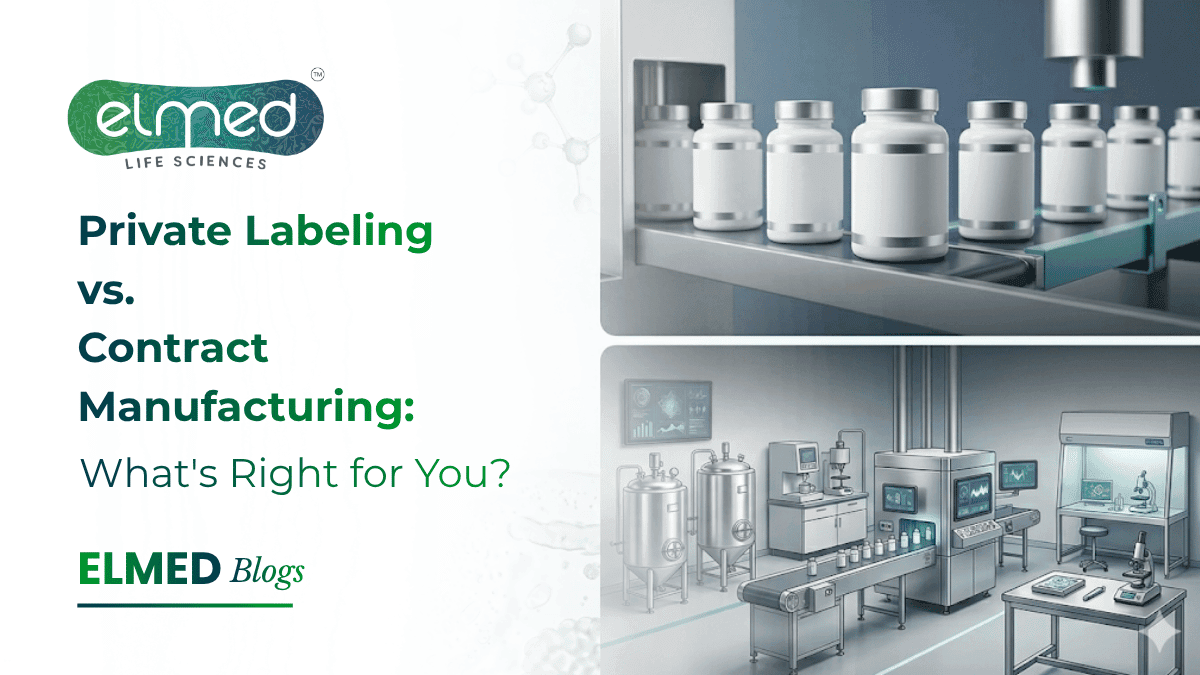


When entering the probiotic supplement market, two main routes are available to brands without manufacturing facilities: private labeling (buying a finished, pre-formulated product and applying your brand) and contract manufacturing (developing a custom formula produced to your specification). Each has a distinct risk-reward profile.
Private Labeling: What It Is
Private labeling means you source an existing, validated probiotic formulation from a manufacturer, apply your own label and packaging, and sell it under your brand. The manufacturer retains the formula, and multiple other brands may carry the identical or near-identical product.
- Fastest time to market (often 4–8 weeks from artwork sign-off)
- Lower minimum order quantities (typically 500–2,000 units)
- No R&D investment required
- Stability and regulatory data already exist for the base formula
- Limited product differentiation—other brands may carry the same formula
Contract Manufacturing: What It Is
Contract manufacturing involves developing a formulation specifically for your brand with a manufacturer who produces it exclusively for you. You own the formula (IP ownership terms vary—confirm this upfront), and competitors cannot access the identical product.
- Full formula customisation: strains, CFU count, format, flavour, and actives
- Proprietary product that cannot be replicated by competitors off the shelf
- Requires longer lead time: typically 3–6 months for first batch
- Higher MOQs (usually 5,000+ units for custom formulas)
- You commission and own the stability and efficacy data
The Hybrid Approach
Many successful brands start with private labeling to validate demand and generate cash flow, then commission a custom formula once they have volume and market data to justify the investment. ELMED supports both routes and can transition brands from private label to custom manufacturing seamlessly.
Private labeling is not a lesser option—it is a strategic choice. The smart play is to launch fast, learn from your customers, then build proprietary IP once you know exactly what the market wants. — ELMED Business Team
Decision Checklist
- Do you need to be in market within 3 months? → Private label
- Is your target segment commoditised? → Custom manufacturing for differentiation
- Budget under $15,000 for initial inventory? → Private label
- Building a brand for acquisition or licensing? → Custom formula (IP value)
- Unsure of formulation requirements? → Private label to test, then customise
Explore More Articles
 Guide
GuideHow to Build a Private Label Probiotic Brand With ELMED
Planning a probiotic brand? See how private labeling works, which formats fit infants, children and adults, and what to check before choosing a manufacturer.
 Guide
GuideInfant & Pediatric Probiotics: Drops, Syrups & Sachets
Learn how infant and pediatric probiotics work, how drops, syrups and sachets differ, and what to consider when selecting probiotic products for children.
Private Label Probiotics From Formulation to Shelf
Private label probiotics move through six stages from formulation to shelf. Learn what happens at each step and what brand owners should check along the way.
Stay in the Loop
Get the latest probiotic industry insights delivered to your inbox.