
Veterinary Quality Standards: What Probiotic Manufacturers Need to Know
Veterinary quality standards help ensure probiotic products are correctly identified, consistently manufactured, microbiologically safe, stable, and suitable for animal-health applications.
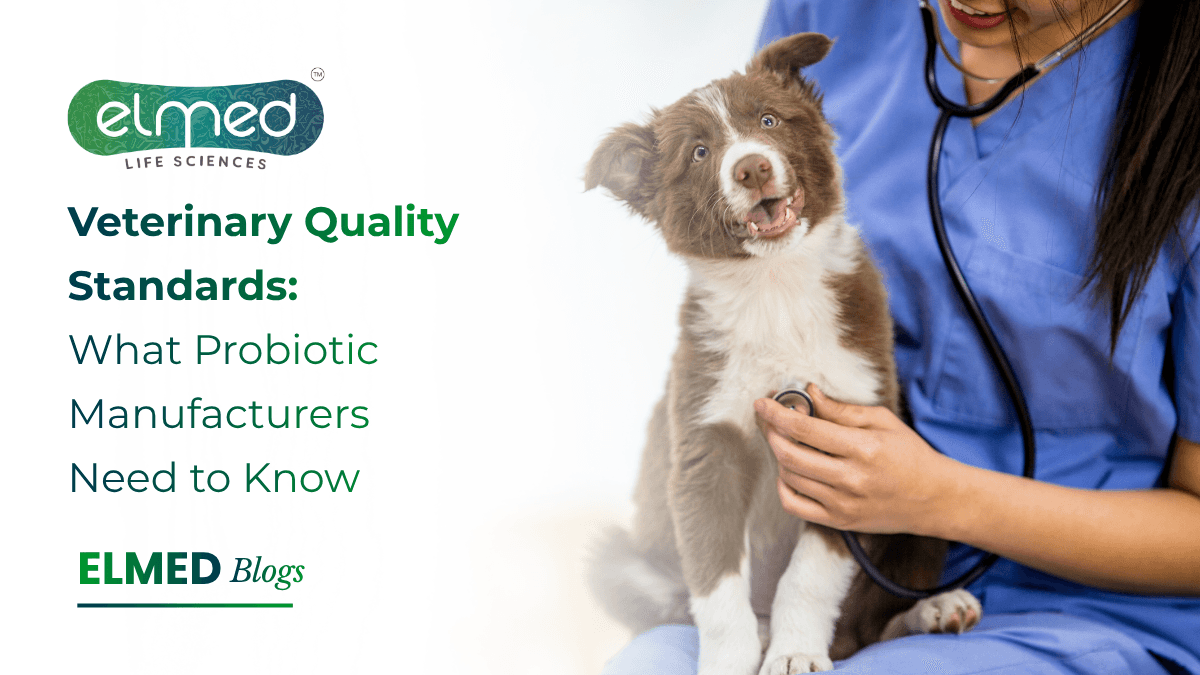


Veterinary Quality Standards: What Probiotic Manufacturers Need to Know
Veterinary quality standards define the manufacturing, testing, safety, stability, documentation, and traceability requirements used to control products intended for animal health and nutrition. For veterinary probiotics, these standards are especially important because the finished product contains living microorganisms that must remain identifiable and viable throughout its shelf life.
Quality starts with the strain.
It does not end at batch release.
Quick Answer
Veterinary quality standards are the systems and technical requirements used to ensure that animal-health products consistently meet their defined specifications for identity, purity, potency, safety, manufacturing quality, and stability.
For probiotic products, quality control includes accurate microbial identification, viable-count testing, contamination control, appropriate manufacturing conditions, stability evaluation, packaging protection, and complete batch documentation.
The applicable requirements depend on the product category, animal species, formulation, claims, and market in which the product will be sold.
Why Veterinary Quality Standards Matter
A veterinary probiotic is not simply a powder containing a large number of microorganisms.
The manufacturer needs to know exactly which organism is being used, how much viable material is present, whether unwanted microorganisms are absent or controlled, and whether the product remains within specification during storage.
That becomes particularly important for products used in poultry, dairy cattle, calves, livestock, pets, and other animals.
A product that meets its specification on the day of manufacture but loses most of its viability during storage is not a well-controlled probiotic product.
Shelf life matters.
Strain Identity Is the Starting Point
For probiotics, microbial identity is one of the most important quality attributes.
The manufacturer should maintain appropriate documentation for the microorganism used in the formulation, including genus, species, and strain designation where applicable.
This distinction is important because two strains belonging to the same species can have different characteristics.
They may differ in:
- Processing tolerance
- Stability
- Gastrointestinal survival
- Antimicrobial susceptibility
- Biological activity
- Manufacturing behavior
A specification that simply says "Lactobacillus" is not enough for serious strain-controlled manufacturing.
The organism must be traceable.
Potency Means Viable Microorganisms
For many probiotic products, potency is expressed through viable microorganisms, commonly reported as colony-forming units or CFU.
The relevant value is the viable count in the finished product under the defined testing method.
This is different from the quantity added during manufacturing.
If a formulation is designed to contain a specific viable count at the end of shelf life, the manufacturing process, formulation, packaging, and storage conditions all need to support that specification.
A high starting CFU number looks impressive on a product label. It does not compensate for poor stability.
Microbial Purity Cannot Be Overlooked
A probiotic product contains microorganisms intentionally.
That makes microbial quality control more complicated than it sounds.
The intended organism needs to remain dominant and correctly identified, while unwanted microbial contamination must be controlled through appropriate raw-material specifications, manufacturing hygiene, environmental controls, validated processes where applicable, and finished-product testing.
For veterinary products, the risk profile also depends on the animal species and intended application.
The quality system should therefore be designed around the actual product rather than copied from a generic supplement specification.
Manufacturing Controls Matter
Veterinary probiotic manufacturing requires controlled processing from raw materials through final packaging.
Key controls include:
Raw material qualification — Ingredients, carriers, excipients, and microbial cultures should meet predefined specifications before entering production.
Controlled fermentation or culture handling — Microbial production needs appropriate process controls to maintain identity and consistency.
Environmental hygiene — Manufacturing areas should be managed to reduce contamination risks.
Batch traceability — Raw materials and finished products should be traceable through documented production records.
In-process controls — Critical manufacturing parameters should be monitored rather than checked only after production.
Finished-product testing — The final batch should be evaluated against its approved specifications.
This is where a real quality system earns its keep.
GMP Certified Manufacturing
Good Manufacturing Practice provides a structured framework for controlling manufacturing operations, personnel, facilities, equipment, documentation, and quality systems.
For ELMED, GMP Certified refers to facility-level Good Manufacturing Practice certification.
It is an important quality foundation for probiotic manufacturing because live microorganisms require controlled handling and consistent production conditions.
However, GMP certification should not be presented as automatic approval for every veterinary product or every destination market.
Product-specific requirements still apply.
US FDA Registered Facilities
For products intended for applicable U.S. markets, facility and product requirements need to be considered separately.
ELMED uses the term US FDA Registered when referring to applicable FDA facility registration.
FDA registration is not the same thing as FDA product approval or FDA certification.
That distinction is important in export communication because regulatory terminology should describe the actual status of the facility or product.
Manufacturers should determine the applicable U.S. requirements based on the product category and intended use before making market-specific claims.
Stability Testing Is a Core Quality Requirement
Probiotics are living microorganisms, so stability deserves more attention than it receives in many product-development discussions.
Temperature, humidity, oxygen exposure, formulation components, processing conditions, and packaging can all affect viability.
For veterinary probiotic powders, moisture control is particularly important. Packaging materials with appropriate barrier properties can help protect the product during storage and distribution.
Stability studies should evaluate whether the finished product continues to meet its defined specifications over the intended shelf life.
The expiry date should be supported by data, not simply by a convenient marketing timeline.
Animal-Specific Quality Considerations
Veterinary quality standards also need to reflect the target animal.
A probiotic for poultry may be manufactured as a feed additive or premix, while a pet probiotic could be supplied as a powder, capsule, chew, or other supplement.
Dairy and livestock products can face additional feed-processing and farm-storage conditions.
The formulation therefore needs to account for:
- Target species
- Dosage
- Delivery route
- Feed compatibility
- Processing conditions
- Storage environment
- Expected shelf life
- Applicable regulatory category
A probiotic that performs well in a laboratory powder does not automatically remain stable after incorporation into commercial feed.
That is a common development mistake.
Documentation and Batch Traceability
Quality standards are supported by documentation.
A properly controlled veterinary probiotic should have a defined product specification and appropriate manufacturing records. Depending on the product and market, documentation can include raw-material records, batch manufacturing records, test results, stability data, packaging specifications, and a Certificate of Analysis.
Traceability allows a manufacturer to determine what was used, how the batch was produced, what testing was performed, and whether the released product met its specification.
Good documentation is not paperwork for its own sake.
It is how quality becomes auditable.
Common Veterinary Quality Mistakes
Choosing a strain without full characterization
A commercial probiotic should not be selected only because its species is familiar. Strain identity and relevant technical characteristics need to be understood.
Using the initial CFU as the final potency claim
Viability can decline during manufacturing, storage, and distribution. Finished-product and stability data are more meaningful than the initial inoculation count.
Ignoring feed-processing conditions
Heat, moisture, pressure, and mechanical stress can affect probiotic survival. Products intended for feed applications should be evaluated under realistic processing conditions.
Treating GMP as product approval
GMP Certified manufacturing demonstrates facility-level manufacturing quality within the certification scope. It does not automatically mean that every product is approved for every market.
Weak documentation
Incomplete batch records or inconsistent Certificates of Analysis make it difficult to establish product quality and traceability.
Choosing a Veterinary Probiotic Manufacturing Partner
When evaluating a manufacturing partner, look beyond the equipment list.
Ask whether the company can demonstrate:
- Verified probiotic strain identity
- Controlled microbial manufacturing
- Viable-count testing
- Microbial purity controls
- Stability testing
- Feed and dosage-form expertise
- Appropriate packaging development
- Batch traceability
- Certificate of Analysis documentation
- GMP Certified manufacturing
- US FDA Registered facility status where applicable
- Support for destination-market requirements
A partner should also understand that veterinary probiotics are not one uniform product category.
Poultry, livestock, dairy, and companion-animal products have different formulation and delivery requirements.
Key Takeaways
- Veterinary quality standards control the identity, purity, potency, safety, consistency, and stability of animal-health products.
- Probiotic strain identity should be clearly established and traceable.
- Viable count should be evaluated in the finished product and monitored through shelf life.
- Microbial purity is essential because probiotic products intentionally contain live microorganisms.
- Manufacturing controls should cover raw materials, microbial processing, environmental hygiene, batch records, and finished-product testing.
- GMP Certified manufacturing provides an important facility-level quality foundation.
- US FDA Registered describes applicable FDA facility registration and should not be confused with FDA product approval or certification.
- Stability testing and moisture-protective packaging are especially important for live microbial products.
- Veterinary probiotic quality systems should reflect the target species, dosage form, feed-processing conditions, and destination market.
The Bottom Line
Veterinary quality standards are not just a compliance exercise. They determine whether a probiotic product remains what the manufacturer intended from production through the end of its shelf life.
For veterinary probiotics, that means controlling the microorganism itself, the manufacturing process, viable count, microbial purity, packaging, storage conditions, and supporting documentation.
The strongest manufacturing approach starts with a clearly characterized strain and follows it through every stage of the product lifecycle.
That is the level of control buyers should expect.
Frequently Asked Questions
Explore More Articles
 Quality
ISO 22000 vs HACCP: What Manufacturers Should Know
ISO 22000 vs HACCP explained for food, nutraceutical, and probiotic manufacturers, including key differences, certification, implementation, and supplier evaluation.
 Quality
Probiotic Syrup Manufacturing: Formulation Guide
Probiotic syrup manufacturing requires careful strain selection, liquid formulation, moisture control, microbial protection, packaging, and stability testing.
 Quality
Veterinary & Animal Health Probiotics
Explore veterinary probiotics, their strains, animal health applications, formulation, stability, manufacturing, quality control, and considerations for different species.
Stay in the Loop
Get the latest probiotic industry insights delivered to your inbox.