
Aquaculture & Agriculture Probiotics: Uses, Strains & Manufacturing
Learn how aquaculture and agriculture probiotics are developed, formulated, manufactured and tested for microbial stability, quality and practical use.
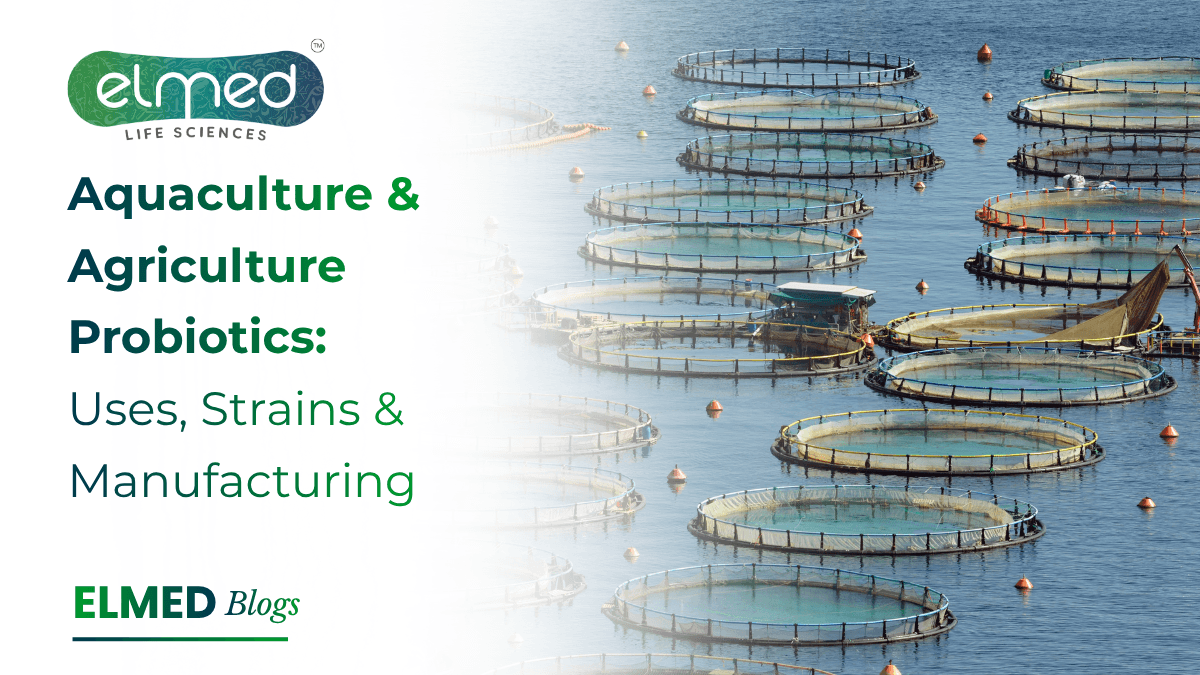


Aquaculture & Agriculture Probiotics: Uses, Strains & Manufacturing
A microorganism that thrives in a shrimp pond and one that thrives in topsoil are solving completely different problems, even if they share a genus name. Aquaculture and agriculture probiotics are microbial preparations built for farming and aquatic production environments — supporting microbial balance, nutrient cycling, or environmental management, depending on the specific application. What they're not is interchangeable with each other, or with human or veterinary probiotics.
Strain selection is just the opening move here. Getting to a real commercial product means working through stability, production scale, storage, real-world application conditions, quality control, and the regulatory demands of wherever the product is actually going to be sold.
Quick answer: These are microbial products developed for use in farming or aquatic systems — in aquaculture, delivered through feed or water-management systems; in agriculture, applied to soil, crops, seeds, or other production inputs. Getting there involves strain identification, safety assessment, functional screening, fermentation, stabilization, formulation, choosing an application method, and confirming viability, shelf life, quality, environmental compatibility, and regulatory fit. A strain that performs well in aquaculture isn't automatically right for soil or crop use — the target environment drives the whole development path.
Why these products matter
Agricultural and aquaculture systems are dense with interacting microbial life — organisms constantly engaging with soil, water, plants, feed, animals, organic matter, nutrients, and shifting environmental conditions. Introducing selected microorganisms into that mix is one strategy researchers use to try to manage it. In aquaculture, that might mean managing the aquatic environment itself or supporting nutrition through feed. In agriculture, it might mean working with soil or plant-associated systems. Because both environments are genuinely complex, results from one microbial preparation don't transfer automatically to a different farming system — even a superficially similar one.
Aquaculture probiotics
These are preparations for fish, shrimp, and other aquatic production systems, delivered through feed or introduced directly into the production environment. Aquaculture systems host organisms that influence water quality, organic matter, nutrient cycling, feed residues, and the animal's own associated microbial communities — meaning development has to account for both the cultured species and everything happening around it in the water.
The main application categories are feed-based products and water-system management products — and they're genuinely not interchangeable, even when built from microorganisms in similar taxonomic groups. A feed probiotic and a water-treatment microbial product face entirely different formulation and stability demands.
Feed-based products have to survive feed-processing conditions — moisture, temperature, storage stress, compatibility with other feed ingredients — while staying viable and easy to administer. A culture that performs beautifully in the lab can lose real viability once it's actually processed into feed, which is exactly why testing has to happen in the finished feed, not just the isolated culture.
Water-application products need evaluation against real water conditions: temperature, pH, salinity, oxygen availability, organic matter, and storage — the organism has to stay stable through application and actually suit the production environment it's headed into.
Proposed mechanisms vary by organism and application: competing with other microbes for nutrients or ecological niches, producing metabolites that shift the surrounding microbial environment, participating in nutrient transformation processes, or interacting directly with the gastrointestinal environment of the cultured animal via feed. None of these are universal — they're strain-dependent, and shouldn't be presented as guaranteed effects of "probiotics" broadly.
Common microbial groups here include Bacillus, lactic acid bacteria, yeasts, and other organisms selected for specific environmental or nutritional roles — with the right choice driven by target species, production system, application method, and actual supporting evidence. Strain identification matters just as much here as everywhere else, since organisms within the same species can behave very differently.
Shrimp and fish farming specifically
Shrimp systems experience real shifts in water quality, organic matter, microbial populations, feed residues, and environmental conditions — and because those conditions vary meaningfully farm to farm, a formulation validated on one shrimp operation still needs evaluation under conditions that actually represent where it'll be commercially used.
Fish probiotics face a similar reality across freshwater, marine, and other aquaculture systems, with development needing to account for the fish species, life stage, feed composition, water conditions, storage, and application method. A probiotic proven for one fish species or environment shouldn't be assumed suitable for every aquaculture system by default.
Agriculture probiotics
"Agricultural probiotic" covers a genuinely broad range of products — for soil, crops, seeds, plant-associated environments, or other production systems, some aimed at nutrient cycling, others at supporting plant-associated microbial communities, others still with different functions entirely. The label "probiotic" here needs interpreting product by product, not as one universal category.
Application methods vary by formulation: soil application, seed treatment, root-zone application, foliar application, irrigation systems, or other agricultural inputs — each with its own technical demands. A soil product has to stay stable in storage and disperse properly on application. A seed-treatment product has to hold viability through coating and storage. A foliar product needs compatibility with actual spray equipment and real environmental exposure.
Soil. Soil hosts a genuinely diverse microbial community involved in decomposition and nutrient cycling, and selected organisms can be investigated for how they interact with it — nutrient cycling, organic matter transformation, microbial diversity, root-associated interactions, general soil biological activity. But the effect depends on soil type, climate, crop, application method, and organism — a product built for one soil environment can behave completely differently in another. And because agricultural environments already host complex microbial populations before anything gets introduced, laboratory performance doesn't reliably predict field performance — the introduced organism's behavior depends on the existing microbes, nutrient availability, temperature, moisture, and soil chemistry it's now competing or coexisting with.
Root-zone (rhizosphere) applications. Plants interact with organisms both around their roots and on above-ground surfaces, and products here investigate root colonization, nutrient availability, microbial competition, and the broader plant-associated microbial community — generally aiming to introduce selected organisms into that environment, not replace what's already there. Formats include powders, granules, liquids, and concentrates, and the physical formulation has to actually disperse correctly in its intended environment — particle size, moisture content, flowability, and dispersion behavior all become genuine quality attributes.
Seed treatment. Organisms applied directly to seeds before planting need to survive formulation, coating, storage, transportation, and application intact — which means seed-treatment formulations often need dedicated carriers and protective systems, while also not interfering with normal seed handling or planting equipment.
Foliar applications. Products sprayed onto plant surfaces bring a different set of demands entirely — suspension stability, sprayability, compatibility with application equipment, environmental exposure, storage stability, and microbial viability all need testing under conditions that actually reflect the intended agricultural use.
Why field testing matters, not just lab data
Controlled lab studies are genuinely useful for characterizing microbial traits, but commercial farming and aquaculture environments are messier and more variable. Field or production-system evaluation checks something the lab can't: real handling, application feasibility, stability during actual use, environmental compatibility, and consistency across variable real-world conditions. A product meant for large-scale agricultural use ultimately needs testing under conditions that reflect real farming practice, not just bench conditions.
Aquaculture vs. agriculture at a glance
FeatureAquacultureAgriculture
Main environment
Water and aquatic systems
Soil, plants, agricultural systems
Common targets
Fish, shrimp, aquatic organisms
Crops, soil, plant-associated systems
Delivery
Feed or water
Soil, seed, irrigation, foliar, other
Key environmental factors
Temperature, salinity, pH, dissolved oxygen
Soil type, moisture, temperature, pH
Major stability concerns
Water exposure and storage
Soil conditions, storage, application
Product design priority
Aquatic-system compatibility
Soil or crop compatibility
Same underlying formulation can perform very differently across these two environments — this is why they need separate development tracks, not a shared one.
Why strain selection carries so much weight
A suitable strain gets evaluated on identity, safety, growth characteristics, stability, environmental tolerance, manufacturing suitability, formulation compatibility, and fit for the intended application. Two organisms from the same species can differ substantially on all of these — and for commercial products, clear strain identity is what supports batch traceability, quality control, reproducibility, and consistency downstream.
Manufacturing, step by step
- Strain selection — chosen against the intended application.
- Strain characterization — identity confirmed, relevant traits evaluated.
- Culture development — a controlled seed culture prepared.
- Fermentation — cultivated under controlled conditions.
- Harvesting — biomass recovered through an appropriate process (centrifugation, filtration, concentration, or similar), designed to minimize unnecessary stress on the organism.
- Stabilization — dried or stabilized through another suitable method.
- Formulation — combined with appropriate carriers or formulation components.
- Packaging — protected against relevant environmental risk.
- Quality testing — checked against predefined specifications.
Fermentation, drying, and formulation can each meaningfully affect viability, which is why process control needs to run through every stage, not just the final check.
Fermentation specifics
Temperature, pH, oxygen availability, nutrient supply, agitation, and duration all shape both growth and consistency — and harvesting at the wrong time, too early or too late, can hurt both yield and quality. None of this generalizes across organisms; the optimal parameters are specific to the microorganism in question, not a shared recipe across products.
Scaling from lab to commercial production
Lab-scale fermentation is relatively easy to keep under tight control. Commercial scale introduces real complications — mixing, oxygen transfer, temperature control, nutrient distribution, fermentation timing, and biomass concentration all behave differently once volume increases. Scale-up needs to be systematic and deliberately engineered, not treated as simply "the same process, bigger tank."
Drying and stabilization
Freeze-drying, spray drying, and other controlled drying methods each carry their own tradeoffs, and the right choice depends on microbial sensitivity, required shelf life, production scale, cost, final dosage form, and storage requirements. Protective formulation components can help organisms survive the process itself.
Dry vs. liquid formulations
FeatureDry formulationLiquid formulation
Storage
Often easier to stabilize
May need tighter control
Moisture
Low-moisture environment
Water-based
Packaging
Moisture barrier often critical
Container compatibility critical
Processing
Requires drying
Liquid processing
Application
Powders, granules, feed
Sprays, concentrates, water systems
Stability
Often better for long storage
Highly formulation-dependent
The right format still comes down to the specific organism and its intended application — neither format is a universal default.
What affects stability
Temperature, moisture, oxygen, water activity, pH, packaging, storage duration, and formulation components all play a role, and sensitivity is genuinely strain-specific — a dry format might store better than liquid for one organism, but that can't be assumed to hold for every microorganism. Stability testing needs to happen on the actual commercial formulation, not a proxy.
Moisture deserves particular attention for dry products specifically: excess moisture can reduce shelf stability, hurt viability, change powder characteristics, and even encourage unwanted microbial growth. Controlling it takes both formulation choices and the right packaging.
Cold-chain considerations
Not every product here needs refrigeration — the right storage condition should come from actual stability data, not assumption. For products distributed into hot climates, developing genuine ambient-temperature stability can be a real commercial advantage, simplifying transportation, warehousing, and farm-level storage considerably.
Why packaging is a stability decision, not a final step
These products pass through manufacturing, storage, transport, distribution, farm-level storage, and finally application — a long chain with plenty of environmental exposure along the way. Packaging needs to protect against all of it. Dry products often need real moisture-barrier packaging; liquid products need the right container compatibility and temperature control.
Quality control
Microbial identity — confirming the intended organism or strain is present. Viability — confirming required concentration is maintained. Purity — screening for unwanted contamination. Physical characteristics — moisture, appearance, particle characteristics, dispersion, pH, and other formulation-specific attributes as relevant. Stability — confirming the product holds spec through its intended shelf life.
Quality control should run through the whole process, not just at the finish line: raw materials checked against specification, fermentation parameters kept within defined limits, intermediate material monitored for microbial concentration and relevant traits, and the finished product checked against identity, viability, purity, physical, and stability specs. That consistency is what makes batch-to-batch manufacturing reliable rather than a matter of luck.
CFU — useful, but not the whole picture
CFU estimates viable organisms capable of forming colonies under defined lab conditions, and it's a legitimate specification — but it's not a complete description of quality. A high count doesn't automatically mean the product suits its intended application; identity, purity, formulation, and stability all still need their own evaluation.
Manufacturing challenges by category
Aquaculture: water conditions (temperature, pH, salinity) affecting survival and activity; feed-processing exposure reducing viability; storage temperature swings during transport and farm handling; and real environmental variability between farms making performance inconsistent site to site.
Agriculture: soil variability (pH, moisture, organic matter, existing microbial populations); climate effects on post-application survival; application-method-specific conditions (soil vs. seed vs. foliar are genuinely different challenges); extended storage before use; and the practical demands of distributing and applying product across large commercial areas.
Microencapsulation for stability
Enclosing organisms in a protective matrix can meaningfully reduce exposure to moisture, temperature swings, processing stress, and general environmental exposure — worth exploring specifically when conventional formulations don't hold up on their own. The right encapsulation system, like everything else here, depends on the organism and intended use.
Synbiotic agricultural products
Combining probiotics with substrates meant to support them is an active area of investigation, but compatibility between organism and substrate needs real evaluation — covering microbial survival, storage stability, formulation compatibility, and application conditions. A synbiotic product needs to be assessed as a complete formulation, not assumed to work just because its individual components each work fine on their own.
Regulatory landscape
Requirements vary meaningfully by country and product category, shaped by composition, intended use, target crop or animal, application method, claims made, and country of sale. Aquaculture products fall under different frameworks depending on whether they're for feed, water management, or another purpose; agricultural products similarly depend on their specific intended use. The regulatory pathway needs establishing before commercial launch — and international sellers should evaluate each target market individually rather than assuming approval in one country carries over to another.
Making claims that actually hold up
Claims should trace back to product composition, scientific evidence, intended use, and regulatory requirements — ideally connecting the specific strain, formulation, application, and outcome as one chain, not making broad claims off species alone. A product built to support a microbial environment shouldn't be marketed with disease-control or treatment language it hasn't earned. And evidence for one application doesn't transfer to an unrelated one — data supporting an aquaculture feed use has no bearing on an unrelated soil application.
Single-strain vs. multi-strain products
Single-strain products offer easier identification, simpler quality control, clearer traceability, and more straightforward stability evaluation. Multi-strain products can combine complementary organism characteristics, but bring real added complexity — strain compatibility, individual stability, per-strain viability, analytical methods capable of distinguishing them, and batch consistency across the combination all need evaluation. The right choice is driven by the actual application and evidence, not simply by how many organisms sound more impressive on a label.
Improving product reliability at the manufacturing level
Maintaining well-characterized microbial banks. Running controlled, well-defined fermentation processes. Setting real critical process parameters. Establishing genuine release specifications. Testing stability in the actual final packaging. Monitoring batch-to-batch consistency. Keeping complete production records. Evaluating any process change through a controlled system rather than informally. These are what separate a reproducible commercial product from a one-off lab success.
Mistakes worth naming directly
Treating all microorganisms as equivalent — strains within a species can differ substantially. Ignoring the application environment — an organism needs evaluation under conditions genuinely similar to where it'll actually be used. Fixating on initial viability — a strong day-one count says nothing about storage performance. Choosing packaging too late — packaging belongs in the stability strategy from the start. Skipping proper scale-up — lab fermentation success doesn't automatically translate to commercial production. Making unsupported claims — claims need to match actual evidence and regulatory standing. Using one formulation across different applications — soil, seed, crop, aquaculture water, and feed each demand different formulation approaches; assuming one solves all of them is a common and costly mistake.
A structured development process
- Define the target application — aquaculture feed, water systems, soil, seed, crops, or another use.
- Select the appropriate strain — identity, safety, stability, functional characteristics.
- Test environmental compatibility — real temperature, pH, moisture, and other relevant conditions.
- Develop the formulation — a delivery system that actually fits the application.
- Establish the manufacturing process — fermentation, harvesting, stabilization, blending, all controlled.
- Develop quality specifications — identity, viability, purity, physical requirements.
- Run stability studies — under conditions that represent real storage.
- Confirm regulatory requirements — for the target country and product category.
- Validate commercial-scale manufacturing — confirming the process stays controlled at real production volume.
Principles worth keeping in view
Start with the application environment — select the strain based on where and how it'll actually be used, not the reverse. Maintain real strain traceability, since clear identity underpins consistent quality. Test the finished formulation, not just the culture in isolation — lab performance of a culture doesn't guarantee performance once it's formulated. Plan stability early, letting storage requirements shape formulation and packaging decisions from the start. Account for real farm-level conditions, since environmental variability genuinely affects performance. Use application-specific formulations rather than one product stretched across feed, soil, seed, and water. Control fermentation carefully, since small process shifts can move biomass output and consistency. Build reproducibility into scale-up from day one. And keep claims evidence-based — don't present a microbial product as a treatment unless the regulatory status and evidence actually support that.
Where the field is heading
Precision microbial selection through advanced characterization, aiming for strains with specific functional traits. Microbiome-based development, using knowledge of existing microbial communities to design more targeted products. Better encapsulation for improved survival through processing and storage. Increasingly application-specific formulations — built for particular crops, soil types, fish species, shrimp systems, or production environments rather than one-size-fits-all. Better ambient stability, making global distribution more practical. And a growing reliance on data-driven development, combining lab, greenhouse, field, and production data to guide strain and formulation choices rather than relying on lab data alone.
Why manufacturing quality is the difference-maker
These products operate in genuinely complex environments, which means manufacturing consistency matters from the very first fermentation batch through to final field application. A quality-focused system holds onto defined microbial identity, consistent viability, controlled purity, batch traceability, stable formulations, and reproducible production — and for commercial developers, that discipline is often exactly what separates a promising lab concept from a product that can actually be manufactured reliably at scale.
The bottom line
Aquaculture and agriculture probiotics sit at the intersection of microbiology, farming, formulation science, and industrial manufacturing — and their success depends on genuinely understanding the environment the organism is headed into. A strain that performs well under lab conditions can behave very differently in soil, a crop system, an aquaculture tank, or commercial feed.
Real success connects strain selection, environmental compatibility, formulation, fermentation, stabilization, quality control, and regulatory planning as one system — not a high viable count treated as the whole product. The finished product needs a clearly defined identity, real stability, controlled quality, and a formulation that genuinely fits its intended use.
As microbial science and agricultural biotechnology keep advancing, expect increasingly targeted products for specific crops, soils, aquatic species, and production environments. For companies entering this space, a manufacturing partner with real experience across fermentation, formulation development, stability testing, and quality-focused production is what actually bridges the gap between a promising strain in the lab and a stable, scalable commercial product.
Frequently Asked Questions
Explore More Articles
 Guide
GuideHow to Launch Your Own Probiotic Brand
Learn how to launch your own probiotic brand, from strain selection and formulation to contract manufacturing, testing, packaging, compliance, and market launch.
 Guide
GuideImportance of In-House R&D in Probiotic Manufacturing
In-house R&D helps probiotic manufacturers control strain selection, formulation, stability, scale-up, testing, and product development from concept to commercial production.
 Guide
GuideQuestions to Ask a Probiotic Manufacturer
The right questions can help brands evaluate probiotic manufacturers for strain expertise, formulation quality, stability, compliance, documentation, and production capabilities.
Stay in the Loop
Get the latest probiotic industry insights delivered to your inbox.