
Fish Farming: Probiotics for Sustainable Aquaculture Health
Fish farming probiotics are formulated to support digestive health, microbial balance, feed utilization, and water quality in aquaculture systems.
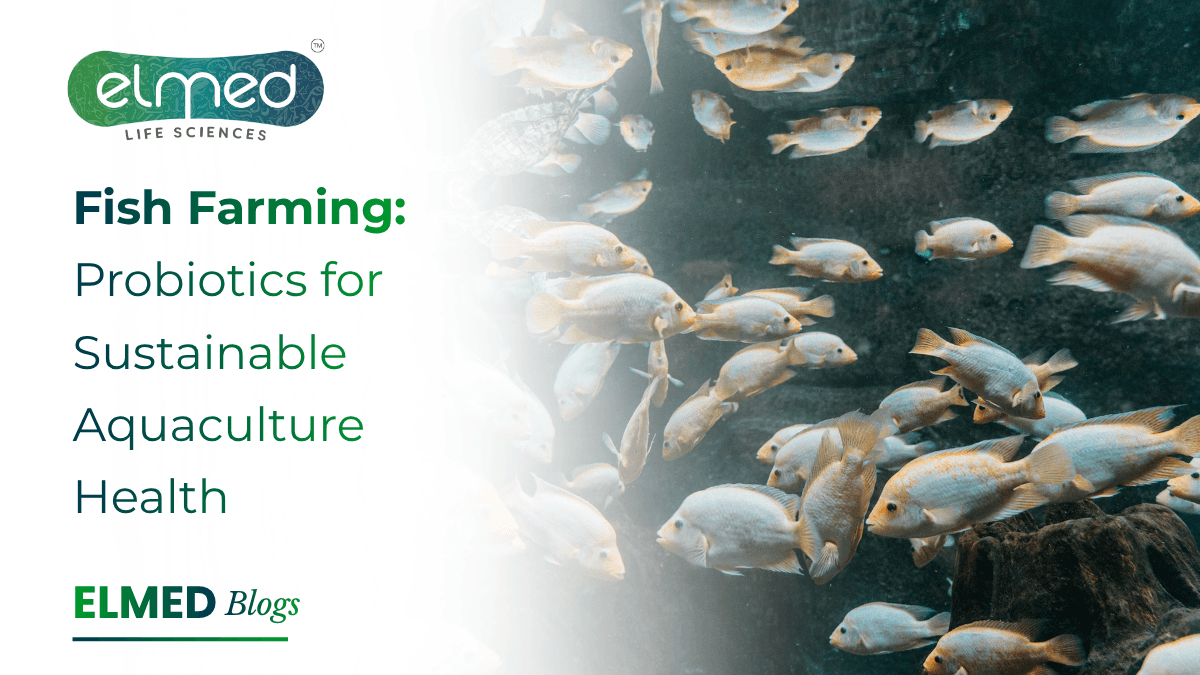


Fish Farming: Probiotics for Sustainable Aquaculture Health
Fish farming is the controlled cultivation of fish in ponds, tanks, cages, raceways, and other aquaculture systems for food production. Probiotics are used in some fish-farming systems as microbial preparations intended to support digestive health, microbial balance, feed utilization, and the quality of the culture environment.
The formulation challenge is different from terrestrial animal probiotics.
Fish live in constant contact with their surrounding water, and that water is part of the production system. A probiotic delivered through feed therefore has a different target from one applied directly to the culture environment.
That distinction should be made before selecting the strain.
Quick Answer
Fish-farming probiotics are selected microorganisms used in aquaculture to support the gastrointestinal microbiota of cultured fish or influence microbial processes in the surrounding water.
Common microbial groups used or investigated in aquaculture include selected Bacillus species, lactic acid bacteria such as Lactobacillus and related organisms, and selected yeasts.
Products may be designed for feed supplementation, direct water application, or specific farm-management programs.
Their performance depends on the fish species, culture system, strain, dose, water conditions, feed matrix, and storage stability. There is no universal "aquaculture probiotic."
Why Probiotics Matter in Fish Farming
Modern fish farming operates at relatively high production densities. Feed enters the system continuously, fish produce waste, and microorganisms drive much of the biological processing that follows.
That creates a complex microbial environment.
The gastrointestinal tract contains its own microbial community, while the surrounding water and sediment contain additional microbial populations. Managing these environments is part of maintaining a stable aquaculture system.
Probiotics can be developed to work in one or both of these locations.
A feed probiotic targets the fish directly. A water probiotic targets the culture environment.
They should not be treated as interchangeable products.
Gut Health and Feed Utilization
Feed is one of the largest operating costs in intensive fish farming, so efficient nutrient utilization matters.
Selected probiotic microorganisms can interact with the gastrointestinal environment through microbial competition, metabolite production, enzyme activity, and other biological mechanisms.
The exact effect depends on the strain.
For example, selected Bacillus strains are known for their ability to produce extracellular enzymes, while selected lactic acid bacteria have been studied for their interactions with intestinal microbial communities.
The practical objective is not simply to increase bacterial numbers.
It is to introduce a defined microorganism at a useful dose in a formulation that survives manufacturing and reaches the intended biological site.
Water Quality Is Part of the Equation
Fish cannot be separated from their water environment.
Parameters such as dissolved oxygen, temperature, pH, ammonia, nitrite, alkalinity, turbidity, and suspended solids influence fish health and production performance.
Microorganisms contribute to nutrient cycling and decomposition of organic material within aquaculture systems. Selected probiotic preparations may therefore be developed for environmental applications in addition to feed use.
But there is a practical limit.
A probiotic does not compensate for inadequate aeration, excessive feeding, poor water exchange, or uncontrolled stocking density.
Those are management problems first.
Strain Selection
Strain selection should begin with the intended application rather than with whatever microorganism is easiest to manufacture.
Relevant considerations include:
- Target fish species
- Freshwater or marine environment
- Expected temperature and pH
- Feed-processing conditions
- Salt tolerance where applicable
- Gastrointestinal survival
- Water dispersibility
- Storage stability
- Intended dose and delivery route
Selected Bacillus strains are particularly attractive for many aquaculture formulations because spore formation can improve resistance to drying and several manufacturing stresses.
That does not mean every Bacillus strain is suitable.
Species names are a starting point. Strain characteristics determine the real formulation decision.
Feed-Based Fish Probiotics
Feed is one of the most practical delivery routes for fish probiotics because it allows the microorganism to enter the digestive tract with the normal diet.
The formulation needs to survive the feed-manufacturing process.
This becomes important when diets are produced through extrusion, pelleting, drying, or other thermal processes. Heat and moisture can reduce the viability of sensitive microorganisms.
For this reason, some products are incorporated after thermal processing, while more process-resistant organisms may be incorporated earlier.
The correct approach depends on the microorganism and the manufacturing process.
A laboratory-stable culture is not automatically feed-stable.
Water-Applied Probiotics
Water-applied products are designed for direct introduction into ponds, tanks, raceways, or other culture systems.
They need different formulation characteristics.
Good dispersibility is important, as is survival after reconstitution. The product should be practical to dose across the intended water volume without requiring unnecessarily complicated preparation.
Storage also deserves attention. Moisture exposure during repeated opening of a powder container can gradually reduce viability.
Packaging is part of the formulation.
Bacillus in Aquaculture
Selected Bacillus species are widely considered in fish and shrimp probiotic development because of their spore-forming characteristics and environmental resilience.
Their potential applications include feed supplementation and microbial management of aquaculture systems.
Some strains produce enzymes such as proteases, amylases, and lipases, which are relevant to the breakdown of nutrients.
However, enzyme production is strain-dependent.
A product should therefore be supported by characterization of the actual strain used rather than by assumptions based solely on the genus.
Manufacturing and Quality Control
Fish-farming probiotics require controlled manufacturing from culture preparation to final packaging.
Important quality attributes include:
Strain identity — Confirms that the intended microorganism is present.
Viable count — Establishes the amount of viable probiotic in the finished product.
Microbial purity — Controls unwanted microbial contamination.
Moisture and water activity — Particularly relevant to dry formulations and shelf-life stability.
Process stability — Determines whether the probiotic survives the intended feed or manufacturing process.
Batch uniformity — Ensures consistent distribution of the microorganism through the product.
Stability — Confirms that the finished product remains within specification during storage.
A high CFU number at production is not enough. What reaches the farm matters more.
Common Mistakes
Choosing a probiotic without defining the target
A product for freshwater tilapia does not necessarily have the same requirements as one designed for marine fish.
Treating all aquaculture species the same
Fish species differ in diet, gastrointestinal physiology, temperature tolerance, and culture environment. Formulation should reflect those differences.
Ignoring feed processing
A probiotic can lose viability during extrusion or pelleting. Manufacturing conditions should be considered during product development.
Using a water product as a feed supplement
The delivery route affects formulation, dose, and stability. Products should be used according to their intended application.
Focusing only on CFU
Viability at release does not guarantee stability through the entire distribution period.
Using probiotics as a substitute for water management
No probiotic can replace adequate dissolved oxygen, appropriate feeding, biosecurity, and routine water-quality monitoring.
Choosing a Fish-Farming Probiotic Manufacturing Partner
A suitable manufacturing partner should understand both microbial formulation and aquaculture production.
Look for capabilities such as:
- Aquaculture-specific strain selection
- Bacillus and lactic acid bacteria formulation
- Feed-grade probiotic development
- Water-dispersible formulations
- Viable-count testing
- Microbial purity testing
- Stability studies
- Moisture-control packaging
- Batch traceability
- Certificates of Analysis
- Export documentation support
The manufacturer should also understand the intended fish species and delivery route.
That sounds basic. It is not always done.
Key Takeaways
- Fish-farming probiotics are used to support microbial balance, digestive health, feed utilization, and aspects of the aquaculture environment.
- Feed-based and water-applied probiotics require different formulation strategies.
- Selected Bacillus strains are useful candidates because spores provide good resistance to several processing and storage stresses.
- Strain-level characterization is more meaningful than species-level selection alone.
- Feed processing, water conditions, temperature, salinity, moisture, and storage can all affect probiotic viability.
- Finished-product viable count and shelf-life stability are important quality attributes.
- Probiotics should complement, not replace, proper feeding, aeration, stocking management, biosecurity, and water-quality control.
- A fish probiotic should be designed around the target species, culture environment, and delivery route.
The Bottom Line
Fish farming makes probiotic formulation particularly interesting because the microorganism is entering a living ecosystem rather than an isolated digestive tract.
That changes the product-development strategy.
A feed probiotic must survive processing and reach the fish in a viable form. A water probiotic needs to disperse through the culture environment and remain useful under actual aquaculture conditions.
The best formulation is therefore not necessarily the one with the highest CFU count or the longest list of microorganisms.
It is the one built around a defined strain, a clear biological target, a realistic delivery system, and demonstrated stability.
For manufacturers, that is where good aquaculture probiotic development begins.
Frequently Asked Questions
Explore More Articles
 Guide
GuideHow to Launch Your Own Probiotic Brand
Learn how to launch your own probiotic brand, from strain selection and formulation to contract manufacturing, testing, packaging, compliance, and market launch.
 Guide
GuideImportance of In-House R&D in Probiotic Manufacturing
In-house R&D helps probiotic manufacturers control strain selection, formulation, stability, scale-up, testing, and product development from concept to commercial production.
 Guide
GuideQuestions to Ask a Probiotic Manufacturer
The right questions can help brands evaluate probiotic manufacturers for strain expertise, formulation quality, stability, compliance, documentation, and production capabilities.
Stay in the Loop
Get the latest probiotic industry insights delivered to your inbox.