Natto and Fermented Foods: Where B. subtilis Occurs in Food
Natto, kinema and other Bacillus-fermented foods explained: how they differ from probiotic products, what they contain and who should take care with them.
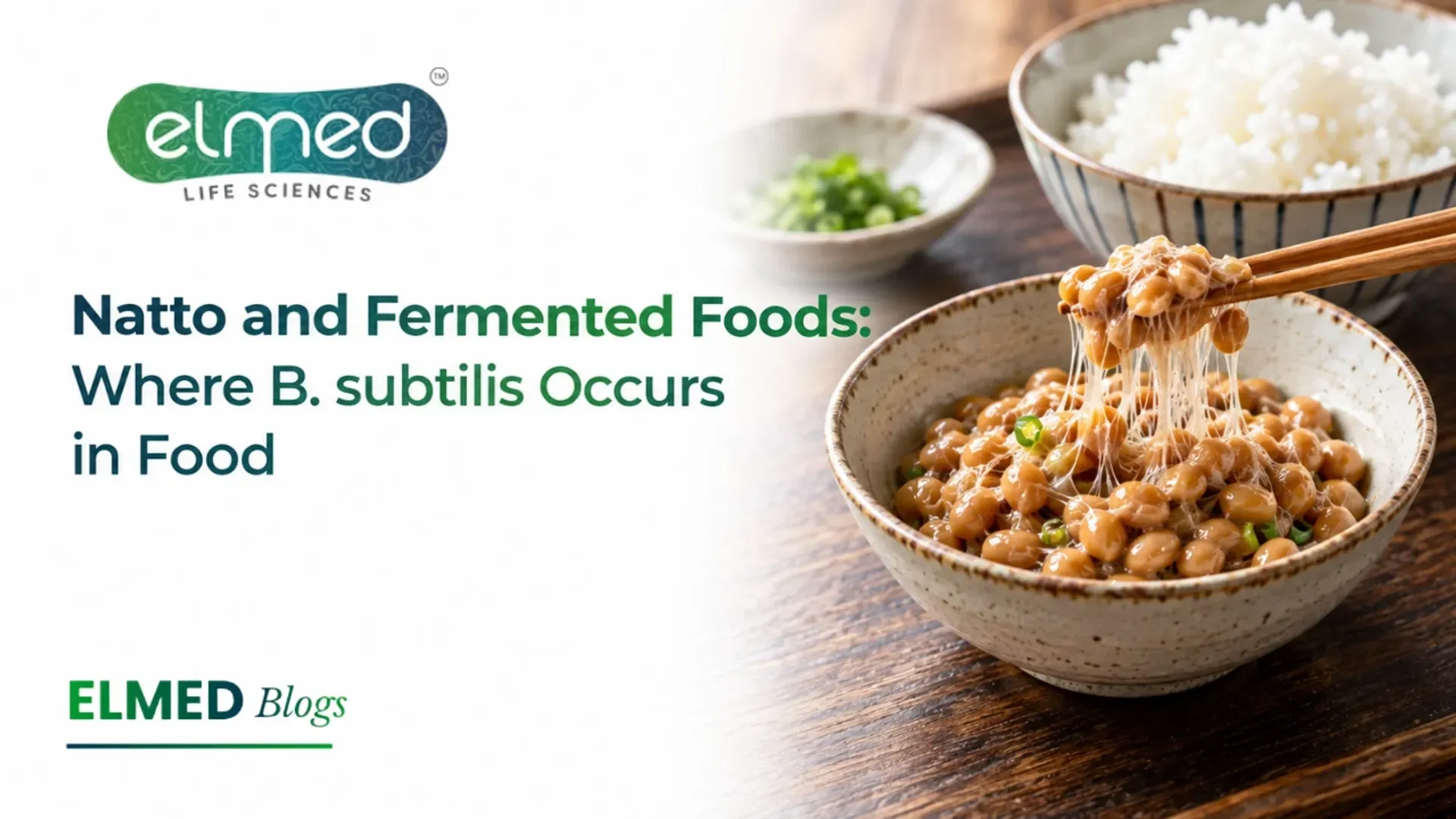


Bacillus subtilis ferments several traditional foods, most notably natto in Japan and kinema in the eastern Himalayan region. These foods contain Bacillus cells and spores along with fermentation products, but they are not standardised probiotics, because strain, count and safety are not controlled in the same way.
What is natto?
Natto is made from soybeans that are steamed and inoculated with a strain of B. subtilis known as var. natto, then held warm for about a day. The result is a sticky, stringy food with a strong smell, eaten with rice in Japan for centuries.
The stickiness comes from poly-gamma-glutamic acid, a polymer made by the bacterium. Fermentation also produces nattokinase, an enzyme studied for its effect on blood clots in the laboratory, and large amounts of vitamin K2 in the form of menaquinone-7.
Is there an Indian equivalent?
Kinema is a fermented soybean food from Sikkim, Darjeeling, Nepal and parts of the Indian north-east. Soybeans are boiled, mashed lightly, wrapped in leaves or placed in jute bags and left to ferment naturally, usually dominated by B. subtilis. It is cooked into curries before eating.
Related Bacillus-fermented foods exist across Asia and Africa, including thua nao in Thailand, doenjang in Korea and dawadawa in West Africa. They are valued as protein-rich flavourings and side dishes.
Do these foods contain probiotics?
Under the accepted scientific definition, a probiotic is a live microorganism that, given in adequate amounts, confers a health benefit demonstrated in studies. Traditional fermented foods meet only part of that definition. They contain live or dormant Bacillus, but usually of unspecified strain, in variable numbers, and without human trials on the product.
Cooking changes the picture further. Kinema is cooked before eating, which kills the vegetative cells though spores can survive. Natto is usually eaten without cooking, so it delivers more intact cells.
Fermented foods have value in their own right. They supply protein, fibre and fermentation products, and add dietary variety. They should be seen as foods and not as stand-in probiotic supplements.
How is a probiotic Bacillus product different?
A probiotic product names the strain, such as B. subtilis CU1, states the CFU per dose and has been through safety assessment. Strains are chosen partly because they do not carry toxin genes or transferable antibiotic resistance genes. The count is controlled across batches and guaranteed until expiry.
None of that applies to a home-fermented food. Quality depends on the starter, hygiene and temperature, and badly handled fermentations can carry harmful bacteria, including B. cereus.
Who should take care with natto?
Natto is rich in vitamin K, which helps blood to clot. People taking warfarin, a vitamin K antagonist, should avoid natto or keep intake constant under medical supervision, because it can reduce the drug's effect. Those taking other blood thinners should ask their doctor.
Soy is also a common allergen. Fermented soy foods are high in sodium when salted, which matters for people with high blood pressure. These cautions apply to the food, not to Bacillus probiotic products, which provide a standard dose of spores without the soy matrix.
What does fermentation add nutritionally?
Fermenting soybeans with Bacillus changes the food. Bacterial enzymes break down proteins into peptides and amino acids, which makes the beans easier to digest and more flavourful. Some anti-nutritional compounds, such as phytic acid, fall during fermentation, improving the availability of minerals like iron and zinc.
Fermented soy foods also supply isoflavones, plant compounds with weak hormone-like activity, and vitamin K2 from natto. These benefits belong to the food as a whole and cannot be credited to the live bacteria alone.
How does this connect to probiotic syrup?
Bacimed Syrup from ELMED Life Sciences contains Bacillus subtilis CU1, a defined spore strain at 2 billion CFU per 5 mL. It offers the strain without the soy, the vitamin K or the strong flavour of fermented beans. The science of spore probiotics is covered in the guide to Bacillus subtilis probiotic syrup.
For general gut health, the more reliable foundation remains a varied, fibre-rich diet. Fermented foods can be part of it if they suit your taste and health conditions.
Frequently Asked Questions
Explore More Articles
 Guide
Antibiotics and Your Pet's Gut: Where Probiotics Fit
How antibiotics disturb a dog's or cat's gut bacteria, why finishing the course still matters, what research says about probiotics during and after treatment, and how to space doses safely.
 Guide
How to Give a Probiotic Sachet to Your Dog or Cat
Practical steps for giving a probiotic sachet to a dog or cat: what to mix it with, how to handle fussy eaters, multi-pet homes, storage, timing with meals and medicines, and mistakes to avoid.
 Guide
Dog Diarrhoea: Causes, Home Care and When to Call the Vet
Why dogs get diarrhoea, how to tell small bowel from large bowel signs, what home care is reasonable, which human medicines are dangerous and which symptoms mean an urgent vet visit.
Stay in the Loop
Get the latest probiotic industry insights delivered to your inbox.