
One Health: Probiotics Across Human, Animal & Environmental Health
One Health probiotics connect human, animal, and environmental health through microbial solutions designed for responsible health, nutrition, and sustainability.
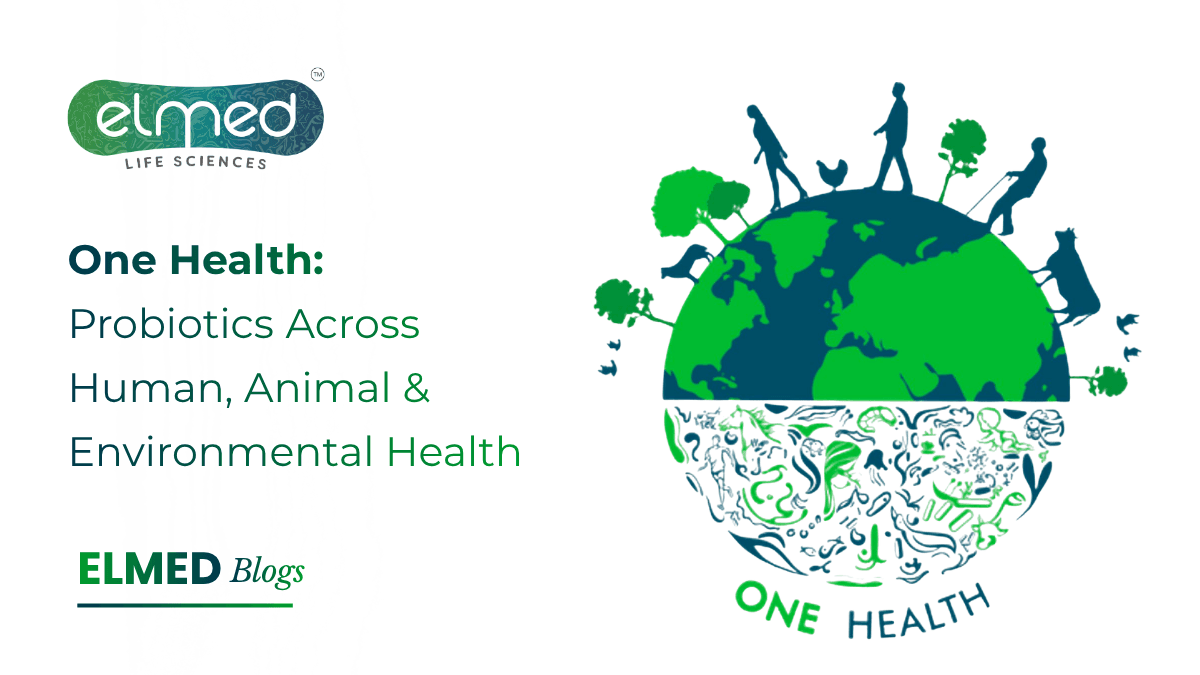


One Health: Probiotics Across Human, Animal & Environmental Health
One Health is an integrated approach that recognizes the close relationship between human health, animal health, and the environment. In probiotic science, this concept is particularly relevant because microorganisms influence the gastrointestinal tract, animal production systems, aquaculture environments, agricultural soils, and broader microbial communities.
The idea is straightforward.
Health systems do not operate in isolation.
A change in one part of the system can influence the others. Antibiotic use, antimicrobial resistance, animal nutrition, food production, water quality, soil health, and microbial ecology all intersect within this broader framework.
Quick Answer
One Health probiotics are microbial products developed with consideration for the interconnected health of humans, animals, and the environment.
In practice, this can include human probiotics for gut health, veterinary probiotics for livestock and companion animals, aquaculture probiotics for fish and shrimp production, and agricultural microbial products intended to support soil and plant health.
The One Health approach does not mean that one probiotic product should be used across all applications. It means that microbial product development considers the wider biological system and its potential effects.
Why One Health Matters for Probiotic Development
Probiotics are living microorganisms, so their development naturally crosses several areas of biology.
A human probiotic interacts with the intestinal microbiota. A poultry probiotic influences an animal production system. A shrimp probiotic enters an aquatic microbial environment. A soil microbial product interacts with plant roots and native soil microorganisms.
These are different applications.
They are connected by one common principle: microorganisms exist within larger biological communities.
That makes responsible strain selection and application important.
Human Health and Probiotics
In human nutrition and healthcare, probiotics are generally defined as live microorganisms that, when administered in adequate amounts, confer a health benefit on the host.
The evidence is strain-specific.
A product containing Lactobacillus rhamnosus GG, for example, should not automatically be assumed to have the same effects as another strain of the same species. The formulation, dose, route of administration, and clinical outcome being studied all matter.
This is particularly important when products are developed for specific applications such as digestive health, antibiotic-associated diarrhea, or women's health.
A large CFU number is not a substitute for evidence.
Veterinary Probiotics Fit the Same Framework
Animals are a major part of the One Health concept because animal health, food production, antimicrobial use, and human health are closely linked.
Veterinary probiotics may be developed for poultry, dairy cattle, livestock, dogs, cats, and other animals.
Applications can include support for gastrointestinal health, feed utilization, microbial balance, and animal production systems.
The formulation must match the species.
A probiotic designed for poultry does not automatically translate to dairy cattle or companion animals. Differences in gastrointestinal physiology, diet, dosage, production conditions, and regulatory requirements all affect product development.
Aquaculture Adds the Environmental Dimension
Fish and shrimp live in direct contact with water, which makes aquaculture particularly relevant to One Health thinking.
Aquaculture probiotics may be delivered through feed or applied directly to ponds, tanks, or other culture systems. Their intended functions can include supporting digestive health, microbial balance, organic-matter processing, and aspects of water-quality management.
The surrounding environment therefore becomes part of the formulation equation.
A probiotic for shrimp farming, for example, must be evaluated not only for microbial viability but also for the practical conditions in which it will be stored, prepared, and applied.
Soil and Plant Microbiology
Agricultural soils contain complex microbial communities that interact with plant roots, organic matter, minerals, and water.
Soil microbial products are developed to support processes associated with nutrient cycling, root-zone microbial activity, and agricultural soil health.
Selected Bacillus and Pseudomonas strains, along with beneficial fungi and other microorganisms, may be considered for different agricultural applications.
Again, strain selection matters.
A microorganism selected for a soil application should be evaluated for its ability to remain viable under the expected soil, storage, and application conditions.
One Health and Antimicrobial Resistance
Antimicrobial resistance, or AMR, is one of the clearest examples of why human, animal, and environmental health need to be considered together.
Antimicrobial use in humans and animals can create selection pressure that favors resistant microorganisms. Resistant organisms and resistance genes can also move through interconnected environments.
Probiotics are being investigated as one part of strategies that could support responsible antimicrobial use, animal health, and microbial management.
They are not replacements for antibiotics when antibiotic treatment is medically or veterinary indicated.
That distinction matters.
The goal is better microbial management, not simply removing effective medicines from the toolbox.
Strain Selection Becomes Even More Important
A One Health approach places greater emphasis on understanding the microorganism being used.
Manufacturers should establish appropriate identity and traceability for the production strain. Depending on the application, evaluation may include:
- Taxonomic identification and strain characterization
- Viable count and potency
- Microbial purity
- Stability during storage
- Environmental tolerance
- Processing tolerance
- Compatibility with the intended host or application
- Safety considerations relevant to the target use
The same species name can cover microorganisms with very different properties.
That is why species-level labeling alone is often inadequate for serious probiotic development.
Manufacturing Quality Connects Every Application
Whether the product is intended for humans, animals, aquaculture, or agriculture, manufacturing quality remains fundamental.
A microbial product should be produced under controlled conditions with appropriate raw-material controls, process monitoring, contamination controls, testing, documentation, and batch traceability.
For ELMED, GMP Certified manufacturing provides a facility-level quality framework, while US FDA Registered refers to applicable FDA facility registration.
Neither term should be interpreted as automatic approval of every product for every market.
The regulatory classification of the finished product still matters.
One Health Does Not Mean One Formula
This is one of the easiest mistakes to make.
A microorganism with a useful property in one application cannot simply be transferred to another product category without evaluation.
A strain used in a human capsule faces different conditions from a strain incorporated into poultry feed. An aquaculture probiotic encounters a completely different environment from a soil microbial formulation.
The development process should therefore begin with the target application, then work backward to strain selection, dosage form, stability requirements, and quality specifications.
That is more reliable than trying to create a universal probiotic.
Common Mistakes
Treating probiotics as interchangeable
Species, strains, doses, and formulations can differ substantially. Evidence for one strain should not automatically support claims for another.
Focusing only on CFU
Viable count is an important quality attribute, but it does not by itself establish biological effectiveness.
Ignoring the environment
Aquaculture and agricultural products interact directly with environmental microbial communities. Product development needs to account for that exposure.
Making broad health claims
Claims should match the evidence and the regulatory category of the finished product. A mechanism observed in laboratory testing does not automatically justify a clinical or agricultural performance claim.
Treating One Health as a marketing phrase
The concept has practical value only when it influences strain selection, safety assessment, manufacturing controls, antimicrobial stewardship, and responsible product use.
Choosing a One Health Probiotic Manufacturing Partner
A manufacturer working across human, veterinary, aquaculture, and agricultural probiotics should have more than basic microbial production capacity.
Useful capabilities include:
- Strain selection and characterization
- Microbial fermentation
- Human and veterinary probiotic formulation
- Aquaculture applications
- Agricultural microbial formulations
- Viable-count testing
- Microbial purity testing
- Stability development
- Appropriate dosage-form development
- Packaging optimization
- Batch traceability
- Certificates of Analysis
- GMP Certified manufacturing
- US FDA Registered facility status where applicable
- Export documentation support
The strongest partner is not necessarily the one offering the largest catalog of microorganisms.
It is the one that understands why a particular strain and formulation are appropriate for a particular application.
Key Takeaways
- One Health recognizes the connection between human, animal, and environmental health.
- Probiotics fit naturally into this framework because microorganisms interact with hosts and surrounding environments.
- Human, veterinary, aquaculture, and agricultural probiotics require different formulation strategies.
- Strain identity and characterization are more informative than species names or headline CFU counts alone.
- AMR highlights the importance of considering antimicrobial use across human and animal systems.
- Aquaculture and agricultural probiotics require additional consideration of environmental microbial communities.
- Manufacturing controls, stability testing, microbial purity, and batch traceability remain essential across product categories.
- One Health does not mean one universal probiotic formula.
- Product claims should remain aligned with scientific evidence and the applicable regulatory category.
The Bottom Line
One Health gives probiotic development a wider perspective.
A probiotic is not simply a bottle, capsule, sachet, feed additive, or agricultural powder. It contains microorganisms that enter a biological system, and that system includes more than the immediate target.
For manufacturers, the practical lesson is clear: start with the intended application, characterize the strain carefully, understand the surrounding biological environment, and build the formulation around real-world use.
That approach produces better products and more responsible claims.
Frequently Asked Questions
Explore More Articles
 Science
Saccharomyces boulardii: Probiotic Yeast Guide
Saccharomyces boulardii is a probiotic yeast used in gastrointestinal formulations, with strain identity, stability, dose, processing, and packaging shaping product development.
 Science
Poultry Probiotics: Gut Health and Feed Applications
Poultry probiotics support gut health and production management by providing selected beneficial microorganisms through feed or drinking-water applications.
 Science
Advanced Probiotic Formulation & Product Development
Explore advanced probiotic formulation and product development, including strain selection, stability, dosage forms, manufacturing, testing, and scale-up.
Stay in the Loop
Get the latest probiotic industry insights delivered to your inbox.