
LGG Sachets, Drops or Capsules: Choosing a Format
How to choose between LGG sachets, drops and capsules: age, dose flexibility, stability, mixing, taste, travel, cost and when a doctor should decide.
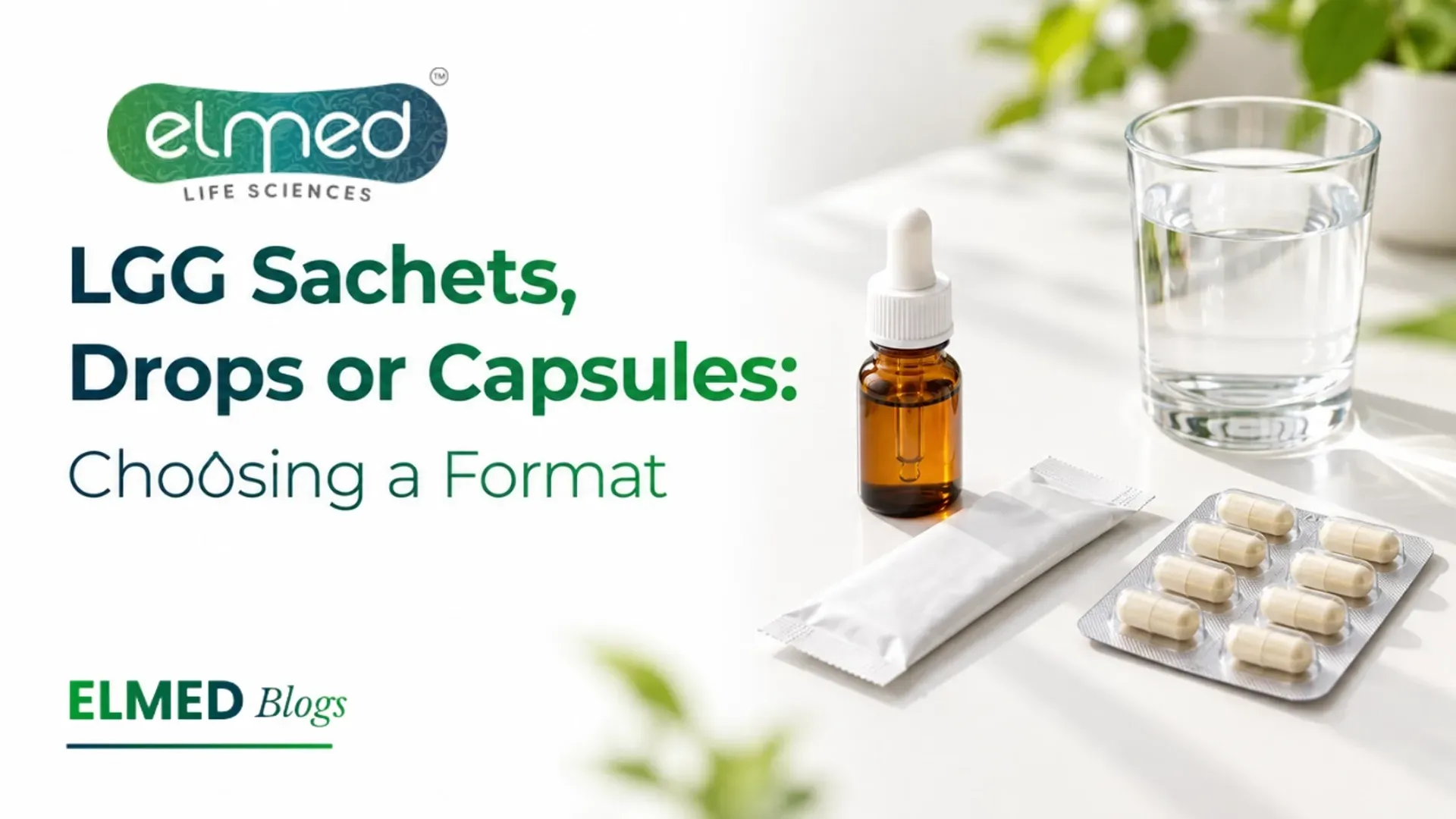


The right LGG format depends mainly on age, the dose needed and ease of use. Drops suit newborns and young infants, sachets suit infants, children and adults who need a larger measured dose, and capsules suit older children and adults who can swallow them. The strain, not the format, carries the evidence, but format affects dose accuracy and adherence.
Does the format change the evidence?
Evidence belongs to the strain at a studied dose. Lactobacillus rhamnosus GG has been tested in capsules, powders, fermented milk, infant formula and drops. A good product delivers the stated number of live LGG cells until expiry, whatever the form. A poorly stored or badly manufactured product can underperform in any form.
What changes with format is practical: how easily a dose is measured, given and tolerated, how stable the product is, and the cost per dose.
What are the formats?
Drops. A liquid suspension, often in oil, given by the drop. They are designed for infants. Rhambac GG Drops from ELMED Life Sciences provide LGG ATCC 53103 at 1 billion CFU per 6 drops. Drops are easy to give to a baby, but each dose is a few drops, so counting must be exact.
Sachets. A single-dose powder mixed with water, milk or soft food. Rhamnosus GG Sachets from ELMED Life Sciences provide LGG ATCC 53103 at 6 billion CFU per sachet. Each sachet is premeasured, which removes counting errors, and it is easily carried.
Capsules and tablets. Suitable for people who can swallow them. They are discreet and convenient for adults, but not for young children.
Fermented foods and drinks. Some products add LGG to dairy drinks. The count and stability depend on the product and the label.
How do the formats compare?
Dose size. Sachets deliver a larger count per unit, which can matter when trials used higher daily doses. In the pooled analysis of antibiotic-associated diarrhoea in children , the largest effect came at 10 to 20 billion CFU per day, a range that drops would need many doses to reach and sachets can reach with a few.
Dose accuracy. A sachet is premeasured. Drops need careful counting. A capsule is a fixed unit.
Ease for babies. Drops are easier for newborns. Sachets can be mixed into a small amount of breast milk or water.
Stability. Dried powders in moisture-protective sachets are usually stable at room temperature. Oil-based drops are formulated to protect the bacteria, and the label states storage. Capsules in blister packs are stable too.
Taste and acceptance. Powders can be tasteless or lightly flavoured. Children vary in what they accept.
Cost and portability. Sachets are light and easy to carry. Drops need a bottle. Capsules are compact.
Which format suits which person?
Newborns and young babies. Drops are a practical choice if a doctor recommends LGG. Premature infants must not receive probiotics without the neonatal team's guidance.
Older babies and toddlers. Either drops or a sachet mixed into a small portion, as the doctor advises.
School-age children. Sachets are usually convenient, since they can be mixed into curd, fruit or water. Capsules suit those who can swallow them.
Adults. Capsules or sachets, depending on preference and the dose chosen.
The age ranges and doses should follow the product label and the doctor, as products differ.
What mistakes occur with each format?
Drops. Miscounting, giving into hot milk or leaving the bottle in heat.
Sachets. Mixing into hot drinks, leaving a mixed drink standing, or using a large drink that is not finished.
Capsules. Opening and mixing without guidance, or storing in humid places.
A guide to practical handling is in the article on how to give a probiotic sachet to a child.
What should be checked on any LGG label?
Whatever the format, check that the label names the strain as LGG or ATCC 53103, gives CFU per dose at expiry, lists other ingredients such as oils, carriers or sweeteners, states storage conditions and shows a batch number and expiry date. An allergy to milk, soy or nuts should be checked against the ingredients, as carriers differ between formats.
Should you switch formats?
If a child is being treated for a condition and a doctor has recommended a certain dose, changing from drops to sachets changes the CFU count per dose. Ask the doctor or pharmacist to convert doses, since 6 drops and one sachet do not contain the same number of cells. For the evidence by condition, see the guide to LGG probiotic sachets.
Frequently Asked Questions
Explore More Articles
 Guide
Antibiotics and Your Pet's Gut: Where Probiotics Fit
How antibiotics disturb a dog's or cat's gut bacteria, why finishing the course still matters, what research says about probiotics during and after treatment, and how to space doses safely.
 Guide
How to Give a Probiotic Sachet to Your Dog or Cat
Practical steps for giving a probiotic sachet to a dog or cat: what to mix it with, how to handle fussy eaters, multi-pet homes, storage, timing with meals and medicines, and mistakes to avoid.
 Guide
Dog Diarrhoea: Causes, Home Care and When to Call the Vet
Why dogs get diarrhoea, how to tell small bowel from large bowel signs, what home care is reasonable, which human medicines are dangerous and which symptoms mean an urgent vet visit.
Stay in the Loop
Get the latest probiotic industry insights delivered to your inbox.